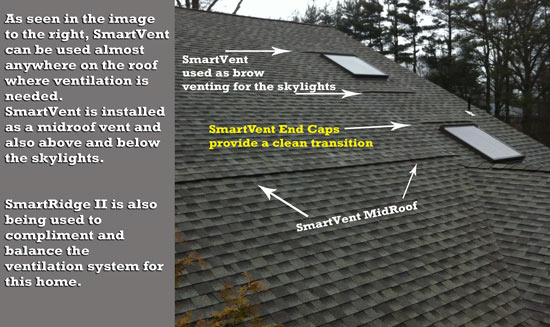
Smart vents can solve difficult roof ventilation problems when traditional soffit vents don’t provide enough airflow or simply won’t work with the home’s design. They can help homes with closed soffits, limited roof overhangs, insulation blocking airflow, dormers, additions, valleys and other complicated roof configurations.
At Portland Roofing Company, we look at ventilation as an entire system. Simply adding more vents doesn’t necessarily improve airflow. The goal is to create a clear path for air to enter the roof system, move through the appropriate ventilation space and exit.
What Is a Smart Vent?
A smart vent is a specialized roof ventilation product that allows contractors to add ventilation in areas where traditional soffit or fascia vents may not work.
One example is SmartVent, a low-profile ventilation product that installers can incorporate beneath shingles along certain areas of the roof deck. Depending on the application, SmartVent can provide intake or exhaust ventilation and can help ventilate difficult areas such as eaves, dormers and other challenging roof configurations.
This gives roofing contractors another option when a home’s design limits traditional ventilation.
A traditional vented attic often uses this basic system:
Soffit intake → attic or rafter ventilation space → ridge or upper-roof exhaust
That system works well when the roof provides a clear, unobstructed pathway.
However, many homes don’t have an ideal setup.
1. Homes With Closed Soffits
Many homes have closed soffits with little or no usable intake ventilation.
Opening the soffits may require significant reconstruction, and some homes simply don’t have enough accessible soffit area to provide the intake ventilation the roof needs.
In these situations, a roof-integrated intake vent may offer another solution.
Instead of rebuilding an entire soffit system, a contractor can evaluate whether the roof can accommodate an alternative intake location.
2. Homes With Limited Soffit Space
Some roofs have soffits, but the available area doesn’t provide enough intake ventilation.
This problem can occur on homes with:
Small roof overhangs
Narrow soffits
Limited eave space
Large attic areas
Long rooflines
Multiple roof sections
A contractor may add intake ventilation along an appropriate section of the roof to increase the available ventilation area.
Some SmartVent applications provide continuous ventilation along a roof edge, while others can address specific areas of a complicated roof.
3. Insulation Blocks the Airflow
A roof can have soffit vents and still lack adequate airflow.
Why?
Because insulation can block the path between the exterior soffit opening and the attic.
When insulation fills the area directly above the soffit, outside air can’t travel into the attic as intended.
Portland’s residential guidance addresses this issue by requiring ventilation baffles that maintain an air space between insulation and the roof deck in applicable situations.
The opening alone isn’t enough. The air needs a pathway.
Before adding ventilation, a contractor should determine whether insulation, framing or another obstruction prevents air from traveling through the intended channel.
4. Dormers and Roof Additions
Dormers and additions often create separate ventilation challenges.
The main roof might have excellent soffit-to-ridge airflow while a dormer or addition has almost no usable intake ventilation.
A specialized intake solution can sometimes provide ventilation to these smaller roof sections without forcing a conventional soffit vent into an area that can’t accommodate one.
5. Valleys and Complicated Rooflines
Complex roof designs can interrupt normal airflow.
Examples include:
Roof-to-wall transitions
Valleys
Dormers
Shed additions
Multiple roof elevations
Skylight areas
Chimney areas
Long sections with limited overhang
Unusual roof shapes
A contractor can evaluate each section individually and determine where the roof needs additional intake or exhaust ventilation.
Can You Install Smart Vents in Just One Area?
Yes. A ventilation system doesn’t always need the same solution across the entire roof.
Depending on the design, a contractor may install ventilation:
In One Specific Area
A dormer, addition or isolated attic section may need additional airflow.
Across One Section of the Roof
A longer run can provide additional intake where the existing soffit system doesn’t provide enough ventilation.
Along an Entire Roofline
A continuous ventilation run can provide intake across a much larger section of the roof when the design calls for it.
In Multiple Areas
A complicated roof may require several ventilation locations to create a continuous airflow path.
The contractor should base the layout on the roof design, attic configuration, existing intake and exhaust, insulation and the requirements of the ventilation product.
Smart Vents vs. Soffit Vents vs. Ridge Vents
These ventilation methods don’t necessarily compete with each other. They often perform different jobs within the same ventilation system.
Vent Type
Primary Purpose
Typical Location
Common Application
Soffit Vent
Intake
Under the eave
Traditional intake ventilation
SmartVent / Roof-Integrated Vent
Intake or specialized ventilation
Roof edge or beneath shingles, depending on product/application
Difficult areas where conventional intake doesn’t work
Ridge Vent
Exhaust
Near the roof ridge
Releases warm and moist attic air
Box Vent
Exhaust
Upper roof
Provides exhaust where a ridge vent isn’t practical
Other Intake Vents
Intake
Eave, fascia or roof edge
Alternative intake locations
The most important factor isn’t the type of vent by itself.
The entire system needs to work together.
Why a Ridge Vent Alone May Not Solve a Ventilation Problem
A ridge vent provides an exhaust opening.
It does not automatically provide the intake air that the system needs.
A traditional ridge-vented attic needs adequate intake ventilation so outside air can enter and replace the air leaving through the ridge.
That means a roof can have a brand-new ridge vent and still experience poor airflow if the soffit intake remains blocked or insufficient.
When traditional soffit intake doesn’t provide enough airflow, a specialized intake solution may help complete the ventilation pathway.
What Happens When Insulation Blocks the Soffit?
This situation deserves special attention.
You might look at a home from the outside and see soffit vents all around the roof.
However, insulation inside the attic may completely block those openings.
When that happens, the roof doesn’t receive the airflow that the exterior vents suggest.
Whether the exhaust system matches the available intake
Sometimes the solution involves correcting the airflow pathway rather than simply adding another exterior vent.
Portland Roof Ventilation: What Homeowners Should Know
Portland homes can have many different roof designs, particularly in older neighborhoods and homes that have undergone additions or remodeling.
You may encounter:
Closed soffits
Older attic construction
Small roof overhangs
Dormers
Multiple additions
Complicated rooflines
Insulation that blocks soffit airflow
Roof sections with limited intake space
Previous roofing work that changed the ventilation layout
Portland’s published residential guidance references Oregon Residential Specialty Code requirements for roof ventilation and net-free ventilation area.
The City of Portland explains that contractors generally calculate the required ventilation area based on the area of the vented space. Certain conditions can allow the use of a 1/300 ratio, but the system must also meet requirements involving the distribution of upper and lower ventilation.
For that reason, contractors should evaluate the entire roof rather than simply count the number of vents.
Why Roof Replacement Provides a Good Opportunity to Improve Ventilation
A roof replacement gives homeowners an opportunity to examine ventilation before the contractor installs the new roofing materials.
During a roof replacement, the contractor can evaluate:
Existing soffit ventilation
Roof intake locations
Ridge or upper-roof exhaust
Insulation around the eaves
Ventilation channels
Dormers
Additions
Roof valleys
Multiple roof elevations
Areas with restricted airflow
The contractor can then determine whether the existing system provides enough intake and exhaust or whether the roof needs additional ventilation.
More Roof Vents Don’t Always Mean Better Ventilation
Many homeowners assume that more vents automatically equal better ventilation.
That’s not necessarily true.
If the intake side doesn’t provide enough air, adding more exhaust vents may not solve the problem.
If insulation blocks the intake pathway, adding another exterior vent won’t necessarily restore airflow.
If the roof has too much exhaust and too little intake, the system may still lack the balanced airflow it needs.
Good ventilation requires the right amount of intake, the right amount of exhaust and a clear pathway between the two.
Smart Vents Can Work as Part of a Larger Ventilation System
Smart ventilation products give roofing contractors another tool when traditional ventilation doesn’t fit the roof.
Depending on the home, a contractor may use:
Soffit intake + ridge exhaust
A common solution for homes with adequate open soffits.
Smart intake + ridge exhaust
An option when traditional soffit intake doesn’t provide enough airflow.
Smart intake + another exhaust method
A possibility when the roof design doesn’t allow a conventional ridge vent.
Targeted smart ventilation
A solution for an individual dormer, addition or difficult roof section.
Continuous smart ventilation
An option when the roof needs additional intake across a longer section.
The contractor should select the configuration based on the home’s actual roof and attic design.
The Bottom Line: Roof Ventilation Should Be Designed, Not Just Added
Your roofing system involves much more than the shingles you see from the ground.
Decking, underlayment, flashing, insulation, drainage and ventilation all affect how the roof performs.
Smart vents can provide a valuable solution when traditional soffit ventilation can’t provide the airflow a roof needs.
They can help address difficult situations involving closed soffits, limited eaves, blocked insulation channels, dormers, additions, valleys and complicated rooflines.
They can also provide ventilation across a small section, a larger roof area or an entire roofline, depending on the roof design and the product’s installation requirements.
The most important question isn’t:
“How many vents can we put on the roof?”
Instead, ask:
“How can we create a clear path for air to enter, move through the ventilation space and exit?”
That approach helps contractors design a ventilation system that works with the home’s actual construction.
If you’re replacing your roof or concerned about poor attic ventilation, ask your roofing contractor to inspect the entire intake and exhaust system before recommending additional vents.
The Fourth of July is one of the most exciting holidays of the year. Families gather for barbecues, neighborhoods celebrate together, and fireworks light up the night sky. While these celebrations create lasting memories, they can also lead to unexpected roof damage that many homeowners don’t discover until it’s too late.
At Portland Roofing Co., LLC, we’ve seen firsthand how Independence Day festivities can result in roofing repairs. Knowing what to watch for can help protect your home and prevent small issues from becoming expensive problems.https://portlandroofingco.com/services-overview/roofing/
Small fires that may not be immediately noticeable
Even if a firework doesn’t ignite your roof, the intense heat can weaken shingles and shorten their lifespan.
Hidden Damage from Falling Debris
After fireworks explode overhead, pieces of cardboard, plastic, paper, and other materials often fall back to the ground. While much of it lands harmlessly, heavier debris can strike your roof and cause:
Cracked shingles
Granule loss
Damaged flashing
Broken skylights
Dented gutters
These problems may not be visible from the ground but can allow water to enter your roofing system over time.
The Fourth of July often falls during the height of summer weather. Wind gusts, heavy rain, and falling tree branches can damage your roof before or after the holiday celebrations.
Outdoor grilling, fire pits, and other holiday activities can also pose risks if they’re too close to your home. Flying embers or accidental flare-ups can damage roofing materials, gutters, fascia boards, and siding.
While your roof is built to withstand the elements, it isn’t designed to handle heat from fireworks or open flames.
Happy Fourth of July from Portland Roofing Co., LLC!
🇺🇸🎆 We hope you and your family have a safe, fun-filled Independence Day celebrating with friends, family, BBQs, and fireworks! ❤️🤍💙
While we all enjoy the festivities, remember that fireworks, summer storms, and unexpected accidents can sometimes cause damage to your roof. If you notice missing shingles, debris, leaks, or any other roofing concerns after the celebrations, we’re here and ready to help.
Whether it’s an emergency repair, a professional inspection, or simply the peace of mind that comes from knowing your roof is in good condition, Portland Roofing Co., LLC is ready to assist.
As a reminder, our office will be closed on Friday, July 3, in observance of Independence Day, and we’ll reopen with normal business hours on Monday, July 6. If you experience roofing damage during the holiday weekend, don’t hesitate to reach out—we’ll get back to you as soon as possible.
We are grateful for the opportunity to serve homeowners throughout the Portland metro area and appreciate the trust you place in our team.
At Portland Roofing Co., LLC, every completed project represents more than just a new roof—it represents a family that can sleep easier knowing their home is protected for years to come.
In the video above, you’ll see one of our recently completed June roofing projects featuring CertainTeed Landmark® shingles in the popular Moire Black color. This homeowner selected Moire Black for its timeless appearance, strong curb appeal, and ability to complement a wide variety of home styles. The finished result is a roof that not only looks beautiful but is built to withstand the demanding weather conditions we experience throughout the Pacific Northwest.
More Than Just a New Roof
A roof replacement is one of the most important investments a homeowner can make. While a roof’s primary purpose is to keep water out and protect the structure below, it also plays a major role in energy efficiency, home value, and overall appearance.
Many homeowners don’t realize that roofing systems involve much more than shingles. Proper underlayment, ventilation, flashing, drainage, and installation techniques all work together to create a complete roofing system. That’s why our team takes the time to ensure every component is installed correctly—not just the parts homeowners can see from the street.
When you choose Portland Roofing Co., LLC, you’re choosing a company that focuses on doing things right the first time.
Proudly Serving the Portland Metro Area
Our office is located at 14415 SE Stark Street in Portland, Oregon, but our service area extends far beyond Portland city limits.
We proudly serve homeowners throughout the Portland Metro area, generally within a 50-mile radius of our office or approximately one hour of drive time.
This includes communities such as:
• Portland • Gresham • Troutdale • Fairview • Wood Village • Happy Valley • Clackamas • Oregon City • Milwaukie • Lake Oswego • West Linn • Tigard • Tualatin • Beaverton • Hillsboro • Forest Grove • Sherwood • Wilsonville • Damascus • Sandy • Canby • Estacada • Vancouver, Washington • Camas, Washington • Washougal, Washington
If you’re unsure whether you’re within our service area, don’t hesitate to reach out. We’re always happy to discuss your project.
We Can Help With More Than Roofing
While roofing is certainly our specialty, many homeowners are surprised to learn that we can assist with a variety of exterior home improvement needs as well.
Depending on the scope of work, we can often help with:
• Gutters and downspouts • Gutter guard installation • Fascia repairs • Soffit repairs • Ventilation improvements • Skylight-related roofing work • Minor siding repairs and replacement • Exterior carpentry projects • Roof inspections • Real estate inspections • Storm damage assessments • Preventative maintenance recommendations
And much more.
If you have concerns about any part of your home’s exterior, it never hurts to ask. If it’s within our wheelhouse, we’d be happy to take a look and discuss options with you.
And if it’s not something we directly handle, we have built strong relationships with many trusted contractors throughout the Portland Metro area over the years. We’re often able to point homeowners in the right direction and connect them with reputable professionals we know and trust.
Our goal has always been to help homeowners find solutions—not just sell roofing projects.
Who We Are
Portland Roofing Co., LLC was built on a simple philosophy: treat customers the way we would want our own families treated.
With more than 30 years of combined industry experience between our ownership team, we’ve seen just about every roofing situation imaginable. From small repairs to complete roof replacements, we understand that every homeowner’s situation is unique.
Unlike many companies, we perform our work with our own crews rather than subcontracting projects out to unknown installers. This allows us to maintain quality control, accountability, and communication throughout the entire process.
We know that replacing a roof can feel overwhelming. That’s why we focus on educating homeowners, answering questions honestly, and helping people make informed decisions that fit their needs and budget.
Over the years, we’ve earned the trust of thousands of homeowners throughout the Portland Metro area because we believe quality workmanship and excellent customer service should never go out of style.
Thinking About Your Own Roofing Project?
If your roof is showing signs of aging, leaking, losing granules, curling, or simply nearing the end of its lifespan, now is a great time to schedule an inspection.
Even if you’re not sure whether the roof is the problem, we’re happy to assess the situation and provide honest feedback.
Whether you need a full roof replacement, a repair, new gutters, gutter guards, exterior carpentry work, or simply a professional opinion, our team is here to help.
Portland Roofing Co., LLC
WE’VE GOT YOU COVERED™
Call today to schedule your free estimate and exterior assessment.
Used to determine whether a user is included in an A / B or Multivariate test.
18 months
_ga
ID used to identify users
2 years
_gali
Used by Google Analytics to determine which links on a page are being clicked
30 seconds
_ga_
ID used to identify users
2 years
_gid
ID used to identify users for 24 hours after last activity
24 hours
_gat
Used to monitor number of Google Analytics server requests when using Google Tag Manager
1 minute
_gac_
Contains information related to marketing campaigns of the user. These are shared with Google AdWords / Google Ads when the Google Ads and Google Analytics accounts are linked together.
90 days
__utma
ID used to identify users and sessions
2 years after last activity
__utmt
Used to monitor number of Google Analytics server requests
10 minutes
__utmb
Used to distinguish new sessions and visits. This cookie is set when the GA.js javascript library is loaded and there is no existing __utmb cookie. The cookie is updated every time data is sent to the Google Analytics server.
30 minutes after last activity
__utmc
Used only with old Urchin versions of Google Analytics and not with GA.js. Was used to distinguish between new sessions and visits at the end of a session.
End of session (browser)
__utmz
Contains information about the traffic source or campaign that directed user to the website. The cookie is set when the GA.js javascript is loaded and updated when data is sent to the Google Anaytics server
6 months after last activity
__utmv
Contains custom information set by the web developer via the _setCustomVar method in Google Analytics. This cookie is updated every time new data is sent to the Google Analytics server.
2 years after last activity
Marketing cookies are used to follow visitors to websites. The intention is to show ads that are relevant and engaging to the individual user.
Google Maps is a web mapping service providing satellite imagery, real-time navigation, and location-based information.