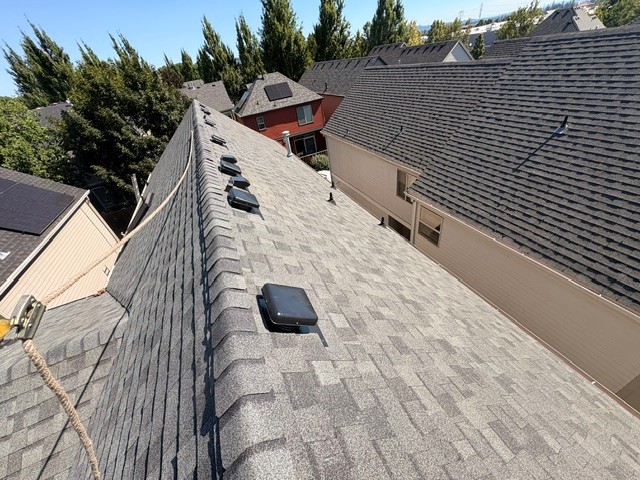
Sharing a Roof Doesn’t Always Mean Sharing the Project 50/50
Not every roofing project involves a single homeowner. At Portland Roofing Co., we understand that some properties have multiple owners sharing the same roof, and we’re happy to work with everyone involved to find a solution that makes sense for the property.
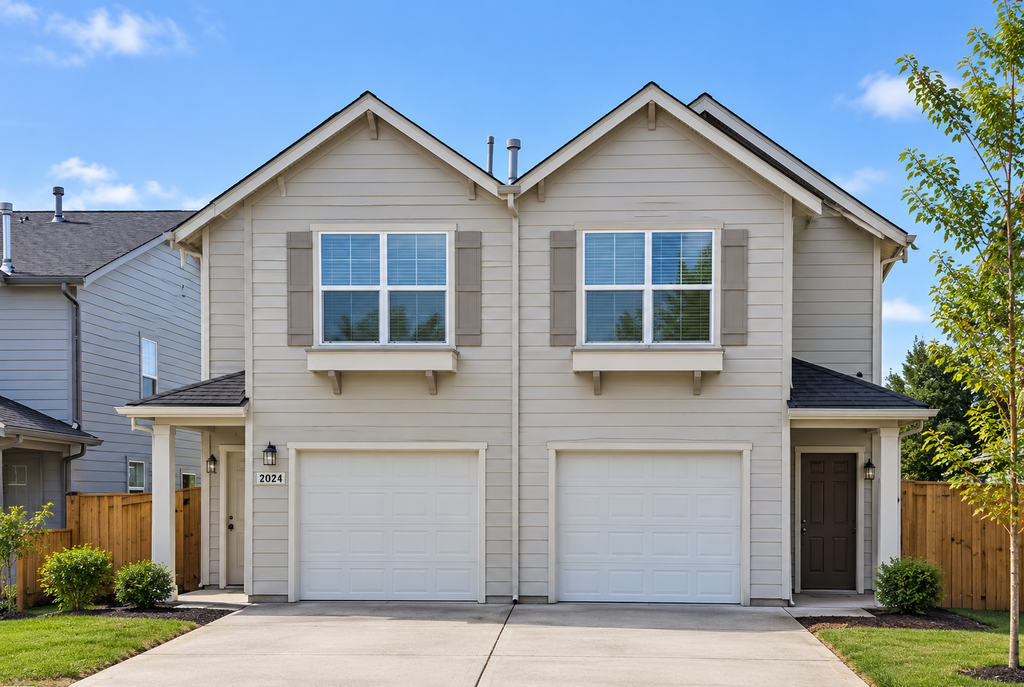
This can include duplexes, townhomes, side-by-side homes, and houses that have been divided into two separate units with different owners.
Every Shared Roof Is Different
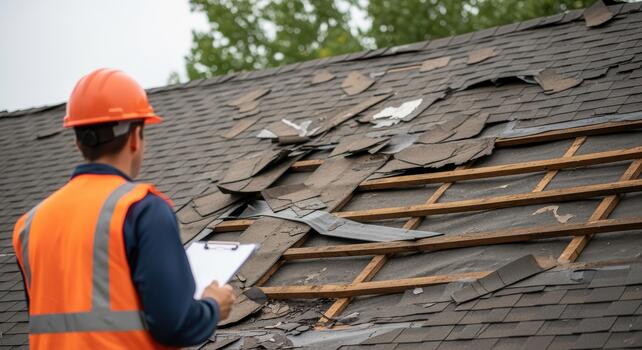
When two owners share a roof, it may seem like the work should simply be divided 50/50. However, that isn’t always the case.
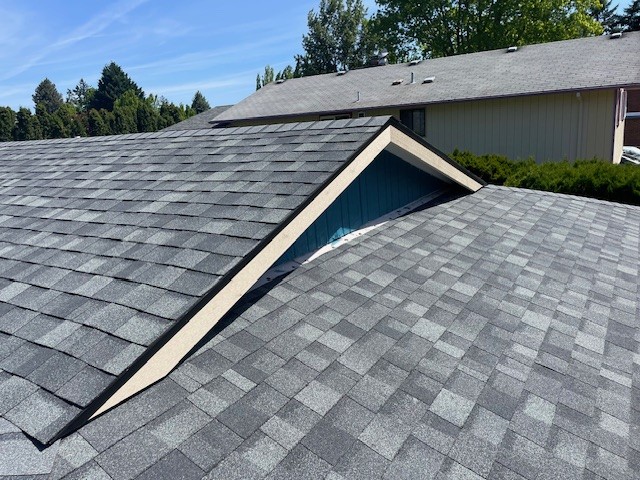
Different home layouts, roof designs, additions, rooflines, and structural features can mean that one portion of a property requires more work than another. Roofing materials, flashing, ventilation, roof access, and underlying roof conditions can also vary between sections.
We’re happy to evaluate the property, discuss the project with the owners, and help determine the best approach based on the actual roofing needs rather than simply splitting everything down the middle.
Working With Multiple Property Owners
We also understand that coordinating a roof repair or roof replacement between multiple owners can feel overwhelming. Our goal is to make the process as straightforward as possible by communicating with the owners involved and helping everyone understand what work is needed.
If you are dealing with a shared roof, you may also want to learn more about roof maintenance and the factors that can affect the cost and scope of a roof replacement.
For additional information about residential roofing standards and building requirements, homeowners can also review resources from the City of Portland and other local authorities.
Whether you need a roof repair, roof replacement, or simply want to understand your options, we’re happy to work with you and the other property owners to figure out a practical solution. Regular maintenance can also help identify roofing problems before they become larger and more expensive issues. Learn more about ways to protect your roof and keep your roofing system in good condition.
Two owners. One shared roof. Different needs. We can help you figure it out.
Contact Portland Roofing Co. today to discuss your shared-roof or split-ownership property.
As summer comes to an end and fall arrives in the Portland area, homeowners know what comes next: rainy Oregon weather.
Fall is a great time to take a closer look at your roof and address small problems before they become expensive repairs. A few simple checks now can help protect your home from leaks, moisture damage, and other roofing problems during the wet months ahead.
Here are five things Portland-area homeowners should check before the heavy rain arrives.
1. Look for Missing or Damaged Shingles
Take a look at your roof from the ground and watch for shingles that are missing, cracked, curled, lifted, or otherwise damaged.
Even a relatively small area of damaged shingles can allow water to get beneath the roofing materials. Strong winds, falling branches, age, and normal weather exposure can all contribute to shingle damage.
If you notice something that doesn’t look right, it’s better to have it inspected before the next major rainstorm.
2. Check for Signs of a Roof Leak
Not every roof leak immediately produces a dripping ceiling. Sometimes the first signs of a problem are much more subtle.
Inside your home, look for:
Water stains on ceilings or walls
Discoloration around ceiling fixtures
Damp or musty odors
Peeling paint
Signs of moisture in the attic
Damp or damaged insulation
If you discover signs of moisture, don’t wait for the next heavy rain to see what happens. Finding the source early can help prevent additional damage.
3. Clean and Inspect Your Gutters
Oregon’s fall leaves can quickly fill gutters and downspouts.
When gutters become clogged, rainwater may not drain properly. Instead, water can overflow against your roof, siding, foundation, or other areas around your home.
Make sure your gutters and downspouts are clear and that water is able to flow away from the house. While you’re checking them, look for loose sections, sagging, cracks, or other damage.
4. Check Your Roof Flashing
Flashing is one of the areas of a roof that deserves special attention.
Flashing helps direct water away from vulnerable areas where different surfaces meet. Common locations include:
Chimneys
Skylights
Roof vents
Valleys
Roof-to-wall connections
Other roof penetrations
Damaged, loose, or deteriorated flashing can create an opportunity for water to enter the home.
5. Don’t Forget About Attic Ventilation
Your roof isn’t just about keeping rain outside. Proper attic ventilation also plays an important role in managing heat and moisture inside the attic.
During Oregon’s cooler and wetter months, excess moisture and condensation can contribute to problems such as damp insulation, mold growth, wood deterioration, and reduced energy efficiency.
If you’re having your roof inspected, it’s worth asking about your attic ventilation as well. A roofing system should be looked at as a whole—not just the shingles on top.
A Little Maintenance Now Can Prevent a Bigger Problem Later
Oregon’s rainy season can be hard on a roof, particularly if there are already underlying issues.
Taking a few minutes to inspect your roof, gutters, flashing, and attic before the weather gets wetter can help identify problems while they’re still manageable.
If you’re unsure about the condition of your roof, Portland Roofing Co., LLC can help you determine whether your home needs a repair, maintenance, or a more comprehensive roofing evaluation.
We’re a local, female-owned roofing company serving the Portland area with in-house crews and no subcontracting.
Smart vents can solve difficult roof ventilation problems when traditional soffit vents don’t provide enough airflow or simply won’t work with the home’s design. They can help homes with closed soffits, limited roof overhangs, insulation blocking airflow, dormers, additions, valleys and other complicated roof configurations.
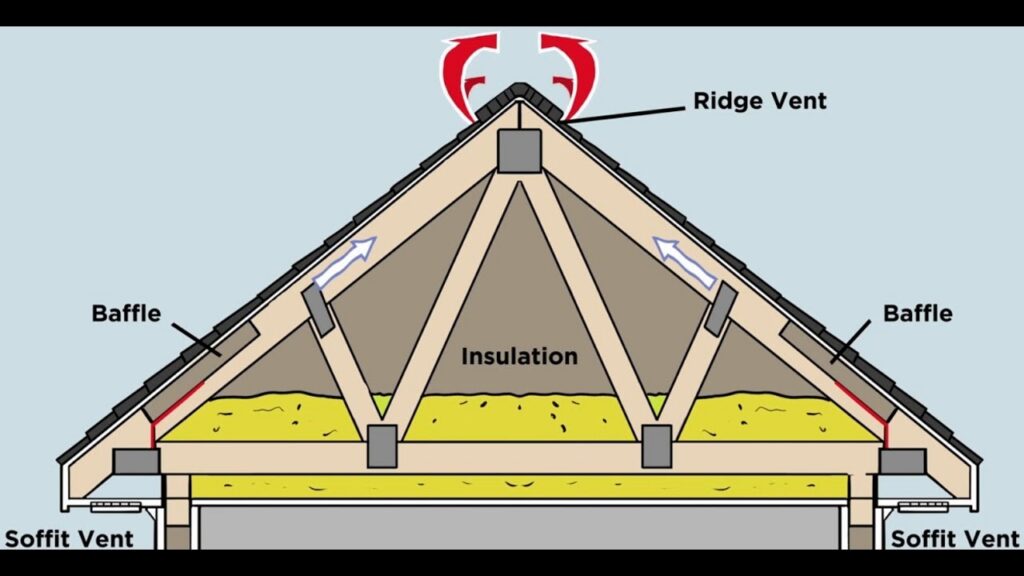
At Portland Roofing Company, we look at ventilation as an entire system. Simply adding more vents doesn’t necessarily improve airflow. The goal is to create a clear path for air to enter the roof system, move through the appropriate ventilation space and exit.
What Is a Smart Vent?
A smart vent is a specialized roof ventilation product that allows contractors to add ventilation in areas where traditional soffit or fascia vents may not work.
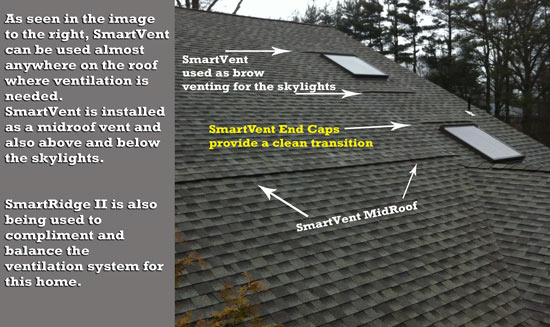
One example is SmartVent, a low-profile ventilation product that installers can incorporate beneath shingles along certain areas of the roof deck. Depending on the application, SmartVent can provide intake or exhaust ventilation and can help ventilate difficult areas such as eaves, dormers and other challenging roof configurations.
This gives roofing contractors another option when a home’s design limits traditional ventilation.
A traditional vented attic often uses this basic system:
Soffit intake → attic or rafter ventilation space → ridge or upper-roof exhaust
That system works well when the roof provides a clear, unobstructed pathway.
However, many homes don’t have an ideal setup.
1. Homes With Closed Soffits
Many homes have closed soffits with little or no usable intake ventilation.
Opening the soffits may require significant reconstruction, and some homes simply don’t have enough accessible soffit area to provide the intake ventilation the roof needs.
In these situations, a roof-integrated intake vent may offer another solution.
Instead of rebuilding an entire soffit system, a contractor can evaluate whether the roof can accommodate an alternative intake location.
2. Homes With Limited Soffit Space
Some roofs have soffits, but the available area doesn’t provide enough intake ventilation.
This problem can occur on homes with:
Small roof overhangs
Narrow soffits
Limited eave space
Large attic areas
Long rooflines
Multiple roof sections
A contractor may add intake ventilation along an appropriate section of the roof to increase the available ventilation area.
Some SmartVent applications provide continuous ventilation along a roof edge, while others can address specific areas of a complicated roof.
3. Insulation Blocks the Airflow
A roof can have soffit vents and still lack adequate airflow.
Why?
Because insulation can block the path between the exterior soffit opening and the attic.
When insulation fills the area directly above the soffit, outside air can’t travel into the attic as intended.
Portland’s residential guidance addresses this issue by requiring ventilation baffles that maintain an air space between insulation and the roof deck in applicable situations.
The opening alone isn’t enough. The air needs a pathway.
Before adding ventilation, a contractor should determine whether insulation, framing or another obstruction prevents air from traveling through the intended channel.
4. Dormers and Roof Additions
Dormers and additions often create separate ventilation challenges.
The main roof might have excellent soffit-to-ridge airflow while a dormer or addition has almost no usable intake ventilation.
A specialized intake solution can sometimes provide ventilation to these smaller roof sections without forcing a conventional soffit vent into an area that can’t accommodate one.
5. Valleys and Complicated Rooflines
Complex roof designs can interrupt normal airflow.
Examples include:
Roof-to-wall transitions
Valleys
Dormers
Shed additions
Multiple roof elevations
Skylight areas
Chimney areas
Long sections with limited overhang
Unusual roof shapes
A contractor can evaluate each section individually and determine where the roof needs additional intake or exhaust ventilation.
Can You Install Smart Vents in Just One Area?
Yes. A ventilation system doesn’t always need the same solution across the entire roof.
Depending on the design, a contractor may install ventilation:
In One Specific Area
A dormer, addition or isolated attic section may need additional airflow.
Across One Section of the Roof
A longer run can provide additional intake where the existing soffit system doesn’t provide enough ventilation.
Along an Entire Roofline
A continuous ventilation run can provide intake across a much larger section of the roof when the design calls for it.
In Multiple Areas
A complicated roof may require several ventilation locations to create a continuous airflow path.
The contractor should base the layout on the roof design, attic configuration, existing intake and exhaust, insulation and the requirements of the ventilation product.
Smart Vents vs. Soffit Vents vs. Ridge Vents
These ventilation methods don’t necessarily compete with each other. They often perform different jobs within the same ventilation system.
Vent Type
Primary Purpose
Typical Location
Common Application
Soffit Vent
Intake
Under the eave
Traditional intake ventilation
SmartVent / Roof-Integrated Vent
Intake or specialized ventilation
Roof edge or beneath shingles, depending on product/application
Difficult areas where conventional intake doesn’t work
Ridge Vent
Exhaust
Near the roof ridge
Releases warm and moist attic air
Box Vent
Exhaust
Upper roof
Provides exhaust where a ridge vent isn’t practical
Other Intake Vents
Intake
Eave, fascia or roof edge
Alternative intake locations
The most important factor isn’t the type of vent by itself.
The entire system needs to work together.
Why a Ridge Vent Alone May Not Solve a Ventilation Problem
A ridge vent provides an exhaust opening.
It does not automatically provide the intake air that the system needs.
A traditional ridge-vented attic needs adequate intake ventilation so outside air can enter and replace the air leaving through the ridge.
That means a roof can have a brand-new ridge vent and still experience poor airflow if the soffit intake remains blocked or insufficient.
When traditional soffit intake doesn’t provide enough airflow, a specialized intake solution may help complete the ventilation pathway.
What Happens When Insulation Blocks the Soffit?
This situation deserves special attention.
You might look at a home from the outside and see soffit vents all around the roof.
However, insulation inside the attic may completely block those openings.
When that happens, the roof doesn’t receive the airflow that the exterior vents suggest.
Whether the exhaust system matches the available intake
Sometimes the solution involves correcting the airflow pathway rather than simply adding another exterior vent.
Portland Roof Ventilation: What Homeowners Should Know
Portland homes can have many different roof designs, particularly in older neighborhoods and homes that have undergone additions or remodeling.
You may encounter:
Closed soffits
Older attic construction
Small roof overhangs
Dormers
Multiple additions
Complicated rooflines
Insulation that blocks soffit airflow
Roof sections with limited intake space
Previous roofing work that changed the ventilation layout
Portland’s published residential guidance references Oregon Residential Specialty Code requirements for roof ventilation and net-free ventilation area.
The City of Portland explains that contractors generally calculate the required ventilation area based on the area of the vented space. Certain conditions can allow the use of a 1/300 ratio, but the system must also meet requirements involving the distribution of upper and lower ventilation.
For that reason, contractors should evaluate the entire roof rather than simply count the number of vents.
Why Roof Replacement Provides a Good Opportunity to Improve Ventilation
A roof replacement gives homeowners an opportunity to examine ventilation before the contractor installs the new roofing materials.
During a roof replacement, the contractor can evaluate:
Existing soffit ventilation
Roof intake locations
Ridge or upper-roof exhaust
Insulation around the eaves
Ventilation channels
Dormers
Additions
Roof valleys
Multiple roof elevations
Areas with restricted airflow
The contractor can then determine whether the existing system provides enough intake and exhaust or whether the roof needs additional ventilation.
More Roof Vents Don’t Always Mean Better Ventilation
Many homeowners assume that more vents automatically equal better ventilation.
That’s not necessarily true.
If the intake side doesn’t provide enough air, adding more exhaust vents may not solve the problem.
If insulation blocks the intake pathway, adding another exterior vent won’t necessarily restore airflow.
If the roof has too much exhaust and too little intake, the system may still lack the balanced airflow it needs.
Good ventilation requires the right amount of intake, the right amount of exhaust and a clear pathway between the two.
Smart Vents Can Work as Part of a Larger Ventilation System
Smart ventilation products give roofing contractors another tool when traditional ventilation doesn’t fit the roof.
Depending on the home, a contractor may use:
Soffit intake + ridge exhaust
A common solution for homes with adequate open soffits.
Smart intake + ridge exhaust
An option when traditional soffit intake doesn’t provide enough airflow.
Smart intake + another exhaust method
A possibility when the roof design doesn’t allow a conventional ridge vent.
Targeted smart ventilation
A solution for an individual dormer, addition or difficult roof section.
Continuous smart ventilation
An option when the roof needs additional intake across a longer section.
The contractor should select the configuration based on the home’s actual roof and attic design.
The Bottom Line: Roof Ventilation Should Be Designed, Not Just Added
Your roofing system involves much more than the shingles you see from the ground.
Decking, underlayment, flashing, insulation, drainage and ventilation all affect how the roof performs.
Smart vents can provide a valuable solution when traditional soffit ventilation can’t provide the airflow a roof needs.
They can help address difficult situations involving closed soffits, limited eaves, blocked insulation channels, dormers, additions, valleys and complicated rooflines.
They can also provide ventilation across a small section, a larger roof area or an entire roofline, depending on the roof design and the product’s installation requirements.
The most important question isn’t:
“How many vents can we put on the roof?”
Instead, ask:
“How can we create a clear path for air to enter, move through the ventilation space and exit?”
That approach helps contractors design a ventilation system that works with the home’s actual construction.
If you’re replacing your roof or concerned about poor attic ventilation, ask your roofing contractor to inspect the entire intake and exhaust system before recommending additional vents.
If you’re wondering, “How much does a roof replacement cost in Portland, Oregon?”, you’re not alone. Roofing costs can vary significantly from one home to another. Because every roof has different features and needs, a professional roofing contractor needs to evaluate the actual roof before providing an accurate estimate.
For example, two homes with similar square footage can have very different roofing costs. However, the size of the home represents only one part of the overall project.
Several factors can affect your total roof replacement cost, including the number of existing roofing layers, roof pitch, decking condition, ventilation, flashing, roof design, materials, repairs, and job-site access.
That’s why a professional roofing estimate should come from an evaluation of your actual roof rather than a quick phone estimate.
Why Can’t a Roofer Give You a Price Over the Phone for a roofing estimate?
It’s understandable that homeowners want a general idea of what a new roof might cost. However, roofing contractors cannot accurately price every project based only on a home’s square footage.
Instead, a contractor needs to evaluate several important factors.
For example, a simple ranch-style home with one layer of roofing may require significantly less work than a home with multiple roofing layers, steep slopes, several valleys, and complicated flashing.
In other words, two roofs that look similar from the street can require very different amounts of labor and materials.
Here are some of the most important factors that can affect your roof replacement cost in Portland, Oregon.
1. How Many Layers of Roofing Are on the Home?
First, your contractor needs to determine how many existing layers cover the roof.
Some homes have only one layer of shingles, while others have multiple layers. As a result, the tear-off process can vary from one project to another.
Removing additional roofing layers requires more labor, time, and disposal. Therefore, the number of existing layers can have a direct impact on your project cost.
A contractor also needs to determine whether the existing roofing materials require special handling or disposal.
2. What Is the Roof Pitch?
Next, your contractor needs to evaluate the roof pitch.
The pitch describes how steeply the roof slopes. Generally, steeper roofs require additional safety precautions and can take more time to work on.
For example, a steep roof may require specialized equipment, additional safety measures, and more labor than a low-slope roof.
Because of these differences, roof pitch plays an important role in determining the labor required for your project.
3. What Condition Is the Roof Decking In?
Underneath your roofing materials, you’ll find the roof decking. This material provides the structural surface that supports your roofing system.
During the roofing process, your contractor may discover damaged, deteriorated, or weakened decking.
Sometimes, homeowners cannot see these problems from the ground. However, your contractor can identify potential issues during the tear-off process.
If the decking needs repairs or replacement, the additional materials and labor can affect the final project cost.
For this reason, a contractor should account for potential decking repairs when explaining your roofing estimate.
4. Does the Home Have Proper Roof Ventilation and will this always be added to the roofing estimate?
In addition to the roof structure itself, your contractor needs to evaluate the ventilation system.
Proper attic and roof ventilation can help manage heat and moisture. Therefore, ventilation plays an important role in the overall roofing system.
Depending on your home’s existing ventilation, your contractor may recommend improvements or replacement of certain ventilation components.
As a result, ventilation requirements can affect both the scope and cost of a roof replacement.
5. How Complicated Is the Roof Design when getting a roofing estimate?
Another important factor is the overall design of your roof.
A simple roof with large, open sections typically requires less work than a complicated roof with multiple sections.
For example, your home may have:
Valleys
Hips
Ridges
Dormers
Additions
Multiple roof sections
Different roof elevations
Roof-to-wall transitions
Because each of these features requires additional planning and installation work, they can affect the total project cost.
In addition, complicated roof designs often require more precise cutting, flashing, and installation.
6. What Flashing Does the Roof Need and will it say in the roofing estimate?
Flashing helps protect areas where water could otherwise enter the roofing system.
For example, flashing may be needed around walls, roof-to-wall transitions, skylights, vents, and chimneys.
Your contractor should evaluate the condition of the existing flashing and determine what the new roofing system requires.
In some cases, existing flashing may remain suitable. In other cases, the contractor may recommend replacement to provide the proper protection for the new roof.
Ultimately, flashing details can affect both the materials and labor required for the project.
7. What Repairs Does the Roof Need?
Before installing a new roof, your contractor should identify visible areas that need repair.
These repairs may involve damaged decking, structural areas, flashing, ventilation components, or other roofing details.
However, some problems may not become visible until the existing roofing materials come off.
That’s why a contractor cannot always determine every repair from a quick visual inspection alone.
A professional contractor should explain any necessary repairs and discuss how they may affect the final cost.
8. How Easy Is It to Access the Property?
Another factor homeowners sometimes overlook is job-site access.
Roofing crews need enough space to safely deliver materials, remove old roofing, set up equipment, and dispose of debris.
For example, fences, landscaping, narrow driveways, detached structures, or limited staging areas can make a project more difficult.
As a result, property access can affect how efficiently a roofing crew can complete the work.
In addition, difficult access may require additional planning or equipment.
9. What Roofing Materials Are You Choosing?
Of course, the roofing materials you select also affect the overall cost.
Different roofing systems have different material costs, installation requirements, warranties, and expected lifespans.
Your estimate may include materials such as:
Asphalt roofing shingles
Underlayment
Ice and water protection
Ridge and hip materials
Ventilation products
Flashing
Roofing accessories
Other installation components
Most importantly, homeowners should compare complete roofing systems rather than comparing shingle prices alone.
A lower-priced material does not necessarily mean a lower overall project cost. Instead, consider the quality of the materials, installation specifications, warranties, and overall value.
Why a Cheap “Ballpark” Price Can Be Misleading
It can be tempting to choose a contractor who gives you the lowest number over the phone.
However, a quick ballpark price may leave out important details.
For example, the initial number may not account for additional roofing layers, decking repairs, flashing, ventilation, difficult access, or other necessary work.
As a result, the final cost could increase once the contractor evaluates the roof in person.
At Portland Roofing Co., we believe homeowners deserve a realistic estimate from the beginning.
Rather than giving you a low number just to get your attention, we prefer to evaluate your roof and explain the work your home actually needs.
That way, you can make a more informed decision before the project begins.
What Should You Expect From a Professional Roofing Estimate?
A professional roofing estimate should clearly explain the work included in your project.
For example, your estimate should provide information about the roofing system, preparation, tear-off, installation, repairs, and other project requirements.
In addition, your contractor should be willing to answer questions about the materials, warranties, installation process, and expected timeline.
You should also understand what the estimate does and does not include.
Most importantly, don’t be afraid to ask questions. A good roofing contractor should want you to understand your project before you sign a contract.
Your Roof Is Unique—Your Estimate Should Be Too
So, how much does a roof replacement cost in Portland, Oregon?
The honest answer depends on your specific home.
Because roofing projects involve much more than square footage, a contractor needs to evaluate the actual roof before providing an accurate price.
The number of existing layers, roof pitch, decking condition, ventilation, roof design, flashing, repairs, accessibility, and materials can all affect the final cost.
For this reason, we don’t believe in giving homeowners a random number over the phone.
At Portland Roofing Co., we evaluate your roof, explain what we find, and provide an estimate based on your home’s specific needs.
In the end, an accurate estimate helps you understand what you’re paying for and reduces the risk of unexpected costs later.
When most homeowners think about their roof, they probably think about shingles. But your roof is actually a complete system made up of several components working together to protect your home from rain, wind, moisture, heat, and the elements.
There are also several things about roofing that many homeowners don’t realize until they have a problem.
Here are five roofing facts every homeowner should know—and a few things you can watch for before a small issue turns into a major repair.
1. Your Roof Can Leak Without a Missing Shingle
One of the biggest misconceptions about roof leaks is that you should be able to look at your roof and immediately spot the problem.
That isn’t always the case.
A roof can develop a leak even when all of the shingles appear to be in place. Water can enter around:
Chimney flashing
Roof vents
Plumbing pipe penetrations
Valleys
Skylights
Wall-to-roof transitions
Damaged or deteriorated flashing
Small cracks or openings
Water can also travel underneath roofing materials before it becomes visible inside your home. This means the location of a ceiling stain isn’t necessarily directly below the actual source of the leak.
The takeaway: If you notice a water stain, discoloration, or moisture on your ceiling, don’t assume the problem is simply one missing shingle. A proper inspection can help identify where the water is actually getting into the roofing system.
2. A Roof Doesn’t Have to Be Old to Have Problems
Age is certainly an important factor when determining how much life a roof has left, but it isn’t the only factor.
A relatively new roof can still experience problems because of:
Severe wind or weather
Storm damage
Improper installation
Poor attic ventilation
Damaged flashing
Moisture intrusion
Manufacturing defects
Damage from trees or falling debris
Even a newer roof deserves attention if you notice missing or damaged shingles, granules collecting in your gutters, leaks, or other signs of damage.
The takeaway: Don’t wait until your roof reaches a certain age to start paying attention to it. Regular inspections and maintenance can help catch problems early.
3. Your Attic Can Affect the Life of Your Roof
Attic
What’s happening underneath your roof can be just as important as what’s happening on top of it.
Proper attic ventilation helps regulate temperature and moisture levels inside your attic. When an attic doesn’t have adequate ventilation, heat and moisture can become trapped.
Over time, excessive heat and moisture can contribute to problems such as premature deterioration of roofing materials, moisture damage, and other issues within the roofing system.
A properly designed roofing system should consider both ventilation and insulation to help create a healthier attic environment.
The takeaway: When evaluating your roof, don’t forget about your attic. Your roof and attic work together as part of your home’s overall building system.
4. Ice & Water Shield Isn’t Just for Snowy Climates
When people hear the term “ice & water shield,” they often assume it is only necessary in areas that experience heavy snow and ice.
That’s not necessarily the case.
Ice & water shield is a waterproof membrane that provides an additional layer of protection in vulnerable areas of a roofing system. Depending on the design of the roof and local building requirements, it may be used around areas such as:
Roof valleys
Eaves
Roof-to-wall transitions
Around certain penetrations
Other areas particularly vulnerable to water intrusion
While the name may suggest that it is strictly a snow-related product, its waterproofing properties can be valuable anywhere water has the potential to work its way underneath the roofing materials.
The takeaway: Roofing isn’t just about keeping rain off the shingles. Proper waterproofing in vulnerable areas is an important part of building a durable roofing system.
5. Your Shingles Are Only One Part of Your Roof
inspecting a roof
This may be the most important thing for homeowners to understand.
When you look at a finished roof, you see the shingles. But the shingles are only one component of the overall roofing system.
A properly installed roof can include:
Roofing shingles
Underlayment
Ice & water protection
Flashing
Ventilation
Roof decking
Pipe flashing
Ridge and/or intake ventilation
Proper fastening
Other components depending on the design of the home
All of these components have a purpose.
That’s why choosing a roofing contractor based solely on the price of the shingles—or simply choosing the lowest bid—may not tell you the whole story.
The quality of the materials matters, but proper installation and attention to the entire roofing system matter too.
Don’t Ignore the Small Signs
One of the best things a homeowner can do is pay attention to small changes.
Keep an eye out for:
Water stains on ceilings or walls
Missing, cracked, or damaged shingles
Shingles that appear to be lifting
Excessive granules in gutters
Damaged flashing
Moss or algae growth
Sagging areas
Water pooling
Increased moisture in the attic
Unexplained musty odors
Not every sign automatically means you need a new roof. In many cases, a smaller repair may be all that’s needed.
The important thing is finding the problem before it becomes a bigger and more expensive one.
Your Roof Is More Than Just Shingles
Your roof protects one of your home’s biggest investments, and there’s much more to it than what you can see from the ground.
Understanding how your roofing system works can help you recognize potential problems, ask better questions, and make more informed decisions when repairs or replacement are needed.
And remember: you don’t have to be a roofing expert to take good care of your roof.
If you’re unsure about the condition of your roof, having it evaluated by an experienced roofing professional can give you a better idea of what you’re dealing with—and whether you need a repair, maintenance, or a complete replacement.
Portland Roofing Co. — We’ve Got You Covered
Serving homeowners throughout the Portland Metro Area, Portland Roofing Co., LLC provides residential roofing services, including roof repairs, roof replacements, and gutter services.
Have questions about your roof? Give us a call or visit PORTLANDROOFINGCO.com to learn more.
You can also BOOK ONLINE for those that prefer not talking on the phone
There’s something about a brand-new roof that just changes the whole vibe of a house.
You pull into the driveway, look at your home, and suddenly think:
“Wow… that looks GOOD.” 😎🏠
That’s the AURA of a new roof.
But a new roof isn’t just about making your home look better. It can improve curb appeal, provide peace of mind, help protect your home from Oregon weather, and make your entire property feel refreshed.
And if you’re thinking about selling your home now or in the near future, a new roof can be an especially valuable improvement.
So let’s talk about why a new roof can do more than simply keep the rain out.
✨ What Exactly Is “Roof AURA”?
AURA is that hard-to-define feeling you get when something looks fresh, clean, finished and well cared for.
A new roof can create that feeling immediately.
The roof is one of the largest and most noticeable parts of your home’s exterior. When shingles are worn, stained, curling, missing or simply showing their age, the entire house can start to look tired—even when everything else is in great shape.
Replace that roof with a clean, modern roofing system?
Instant AURA.
It’s like giving your house a new haircut, except this haircut protects your home from the weather. 😂
🏠 Curb Appeal Starts at the Top
Your roof can have a major influence on how your home looks from the street.
A fresh roof creates clean lines and gives the exterior a finished appearance. Choosing the right shingle style and color can also complement your siding, trim, windows, landscaping and overall architectural style.
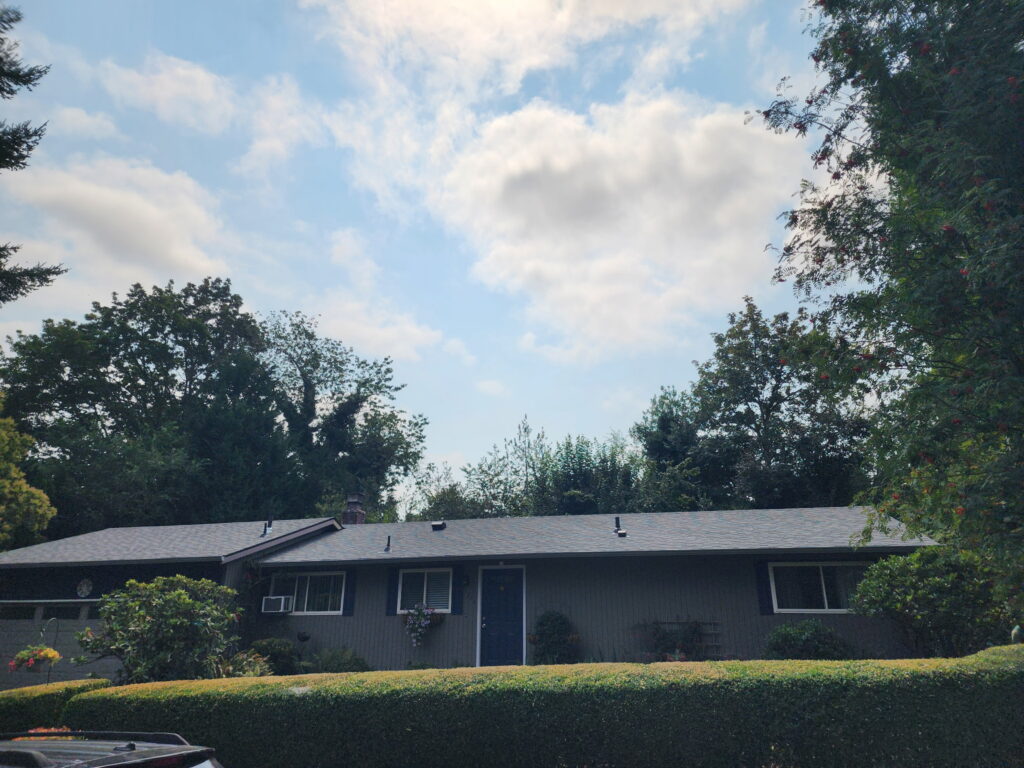
For example, the Estate Gray shingles used on this recent ranch-style home provide a classic, neutral appearance that works beautifully with many exterior color combinations.
And that’s one of the fun parts of replacing a roof:
You aren’t just replacing something old—you’re giving your home a fresh new look.
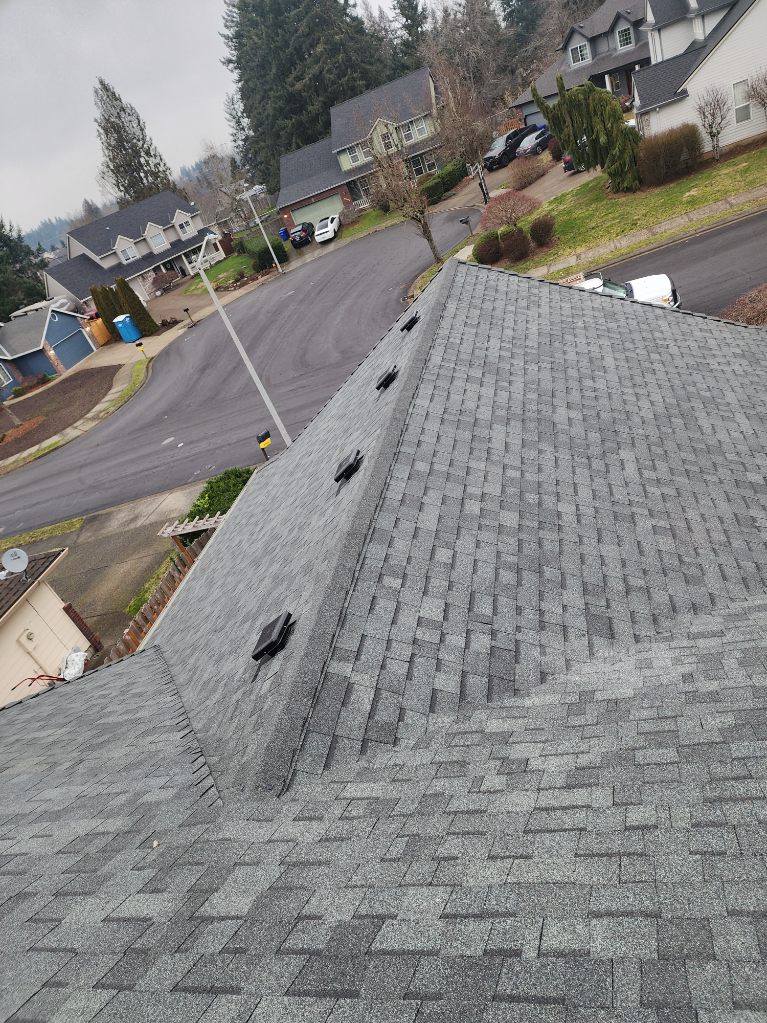
📸 The Difference Is Even Better From Above
Sometimes the best way to appreciate a new roof is to see it from the air.
A top-down photo can show just how uniform, clean and consistent a new roof looks after installation.
Then you see the street-level photo and realize:
“Oh… THAT’S the AURA.” 😎
The combination of a clean roof, finished edges and a fresh exterior can make a home look dramatically different without changing the home’s structure at all.
🔨 But It’s More Than Just Looks
As great as the AURA is, the most important job of a roof is still protection.
A properly installed roofing system helps protect the home from rain, wind and the everyday weather conditions that Portland-area homes experience.
During a roof replacement, our crews also look beneath the shingles.
On this particular ranch-style home, we discovered areas of damaged plywood decking that needed to be replaced before the new roofing system could be installed.
That’s an important part of the process.
A beautiful roof is great.
A beautiful roof installed over a solid foundation is even better.
🛠️ A New Roof Can Bring Peace of Mind
One of the biggest benefits homeowners experience after replacing an aging roof isn’t something you can photograph.
It’s peace of mind.
Instead of wondering:
Is that stain on the ceiling getting worse?
Will the next big rain cause a leak?
How much longer can I get out of these shingles?
Is the roof going to make it through another Oregon winter?
You can simply look at your new roof and know that you’ve invested in protecting your home.
That’s a pretty good feeling.
That’s part of the AURA, too.
🏡 Selling Your Home? Don’t Forget the Roof.
If you’re planning to sell your home now or sometime in the near future, the condition of your roof can become an important part of the selling process.
A roof that’s near the end of its life can create questions, negotiations and potential headaches during the inspection and closing process.
A prospective buyer may see an aging roof and immediately start wondering:
“How much is this going to cost me?”
And that’s where a new roof can make a big difference.
Having the roof replacement completed before putting your home on the market can help eliminate one major concern for potential buyers. Instead of seeing an aging roof that may need attention soon, buyers see a freshly installed roofing system and one less major project they need to take on.
Less uncertainty. Fewer surprises. More confidence.
A new roof can also make your home more attractive to buyers who are looking for a home that’s move-in ready.
And let’s be honest—when buyers are scrolling through listings, a home with a fresh exterior and a beautiful new roof is going to make a stronger first impression than one with visibly worn roofing.
That doesn’t mean a new roof guarantees a higher sale price or eliminates every inspection issue. But it can help your home stand out, reduce one potential source of negotiation, and make the buying process feel easier and less intimidating.
If you’re already thinking about selling, it may be worth asking yourself:
“Would I rather replace the roof now—or wait until a buyer’s inspection brings it up?”
Sometimes taking care of the roof before listing can save you time, stress and headaches later.
And yes…
It adds AURA. 😎
💰 A Fresh Roof Can Make the Home Feel More Valuable
RECENTLY COMPLETED ESTATE GRAY – BRAND NEW FEEL
A new roof can contribute to the overall appearance and condition of a property.
For homeowners considering selling in the future, a worn-out roof can be one of the first things potential buyers notice.
A fresh, professionally installed roof can help create a positive first impression and demonstrate that the home has been properly maintained.
Even if you’re not selling anytime soon, there is something satisfying about knowing your home looks its best.
🎨 The Color Matters
Roof color can completely change the personality of a home.
That’s why choosing the right color isn’t something we take lightly.
For this project, the homeowners chose Owens Corning Oakridge® shingles in Estate Gray, creating a classic look that complements the simple lines of the ranch-style home.
Gray tones can provide a timeless appearance without overpowering the rest of the exterior.
And when the sun hits a freshly installed roof?
Yep. More AURA. ✨
🌧️ Especially Here in Oregon
Oregon roofs have a lot to deal with.
Rain, wind, moss, changing temperatures and long stretches of wet weather can all take their toll over time.
A new roofing system gives homeowners the opportunity to address aging materials, repair damaged decking where needed and start fresh with a properly installed roof system.
For this project, the result was a 30-year Owens Corning roof system that gives the homeowner a fresh appearance and long-term protection.
❤️ Sometimes You Don’t Realize How Much You Needed It
One of the most common reactions homeowners have after a roof replacement is:
“I didn’t realize how bad the old roof looked until I saw the new one.”
And that’s completely understandable.
When you’ve lived in a home for years, you stop noticing the little things.
The faded shingles.
The discoloration.
The worn areas.
The general “tired” look.
Then the new roof goes on…
And suddenly the house looks new again.
✨ So, What Is AURA?
AURA is the combination of everything you feel when your home looks refreshed and protected.
It’s:
✨ Better curb appeal.
✨ A clean, finished appearance.
✨ A fresh color and style.
✨ Protection from the elements.
✨ Confidence in your roofing system.
✨ Less worry when it’s time to sell.
✨ And that “WOW, look at my house!” feeling.
A new roof doesn’t change the address.
It doesn’t change the floor plan.
It doesn’t change the neighborhood.
But sometimes, it can completely change the way you feel when you pull into the driveway.
That’s the AURA of a new roof. 🏠✨
And if your roof is starting to look a little less “WOW” and a little more “WHEN DID THAT HAPPEN?”…
It might be time to give it a closer look. We are able to come out and give a free estimate!
Why Modified Bitumen (Torchdown) and Two-Layer Roofing Systems Are Popular Choices in Portland Oregon
If you have a flat or low-slope roof, choosing the right roofing system is different from choosing asphalt shingles for a traditionally pitched roof.
A steep roof is designed to shed water quickly. A low-slope roof has much less pitch, so the roofing membrane itself plays a major role in keeping water out of the building.
One of the established roofing systems used for these applications is modified bitumen roofing, commonly called torch-down roofing.
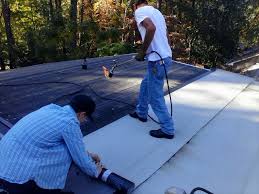
Portland Roofing Company installs modified-bitumen roofing systems on appropriate residential and commercial low-slope roofs throughout the Portland area. For many applications, we prefer a two-layer membrane system, providing an additional layer of roofing protection rather than relying on a single membrane.
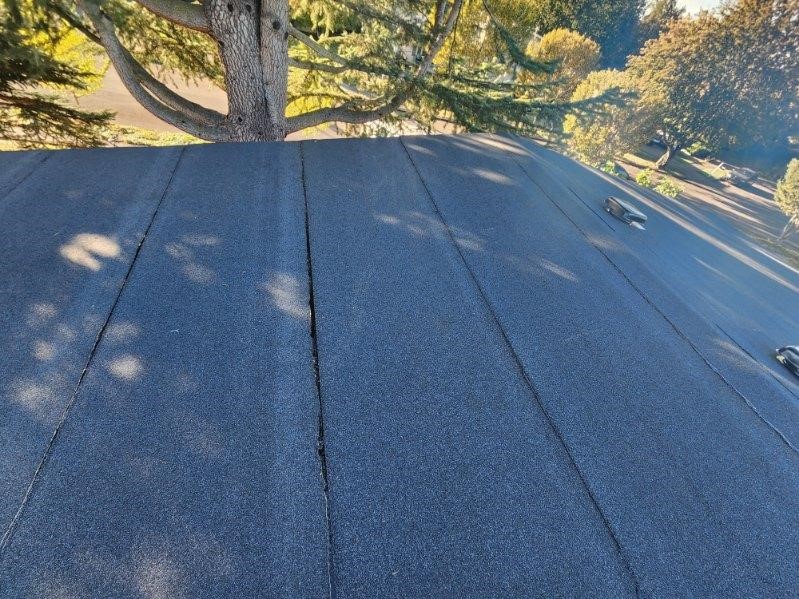
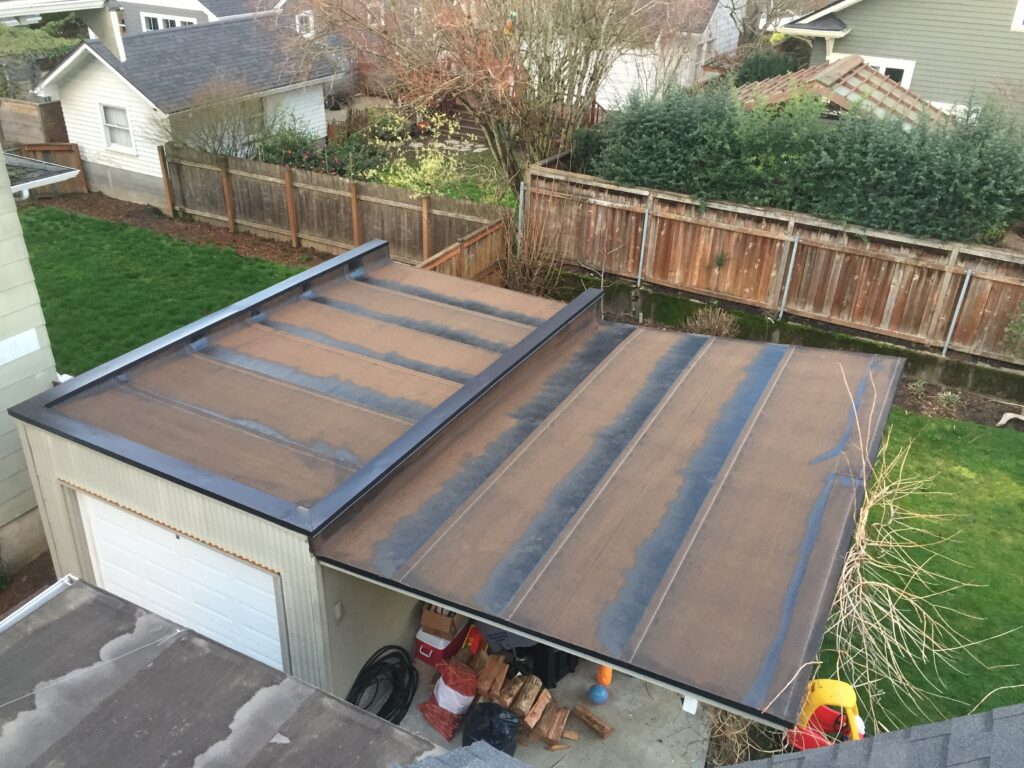
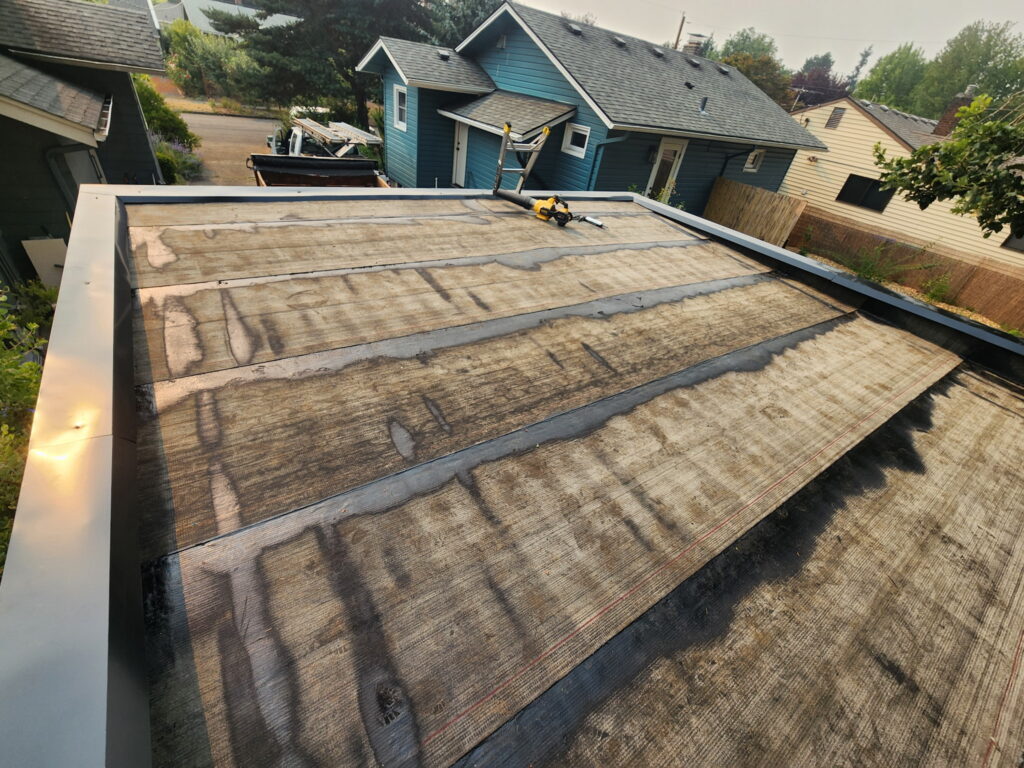
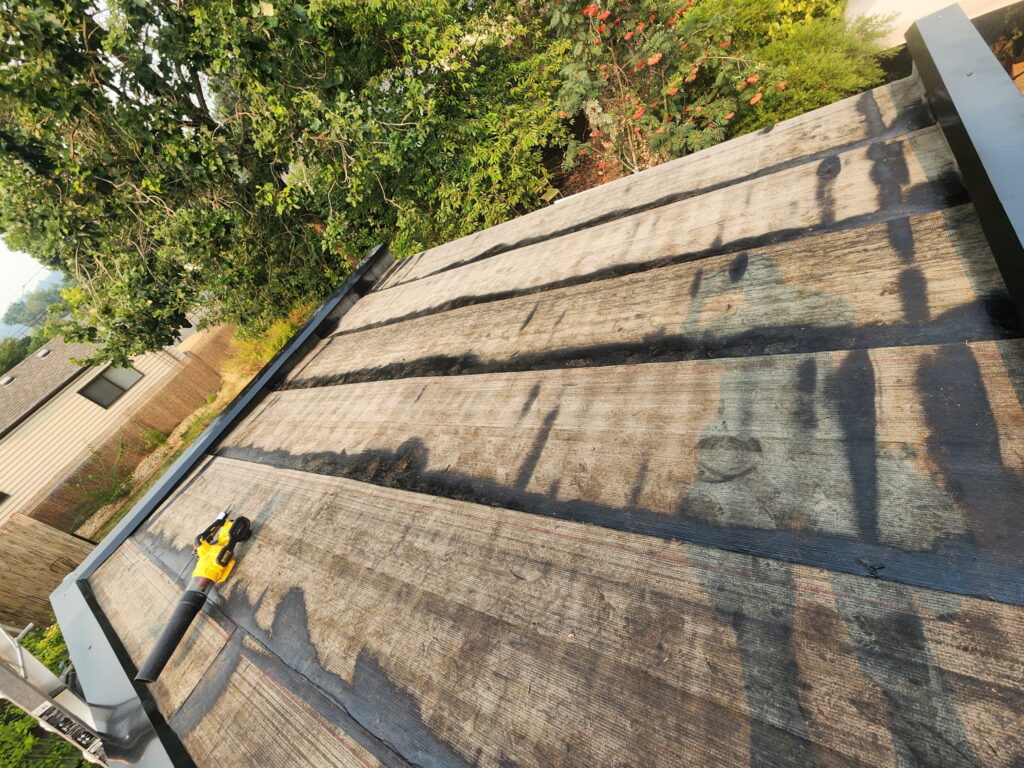
The photos accompanying this article show a recent Portland Roofing Company project in North Portland: a detached garage where we installed a double-layer smooth-surface torch-applied roofing system, along with custom-fabricated cap metal around the parapet walls.
What Is Torch-Down Roofing?
“Torch-down” is the common term homeowners use for a type of torch-applied modified bitumen membrane roofing.Torch-Down Roofing is used for Flat & Low-Slope Roof structures that have a slope that is too shallow to put shingles on it.
Modified bitumen is an asphalt-based roofing material that has been modified with polymers to improve characteristics such as flexibility and resistance to temperature changes. It is specifically designed for low-slope roofing applications.
Modified-bitumen systems can be installed using several methods, depending on the product and manufacturer’s specifications, including torch application, cold-applied adhesives, and self-adhered systems.
APP modified-bitumen membranes are commonly torch-applied, while SBS modified-bitumen systems can be installed using several different methods. GAF notes that typical modified-bitumen systems often consist of multiple membrane layers, such as a smooth base or ply sheet combined with a cap sheet.
So when someone says they have a “torch-down roof,” it is worth asking what specific roofing system is actually being installed.
Not every torch-down roof is the same.
Why Is Modified Bitumen Used on Flat Roofs?
Flat and low-slope roofs have a different water-shedding challenge than steep-slope roofs.Torch-Down Roofing for Flat & Low-Slope Roofs is used when regular shingles cannot be used due to water not being able to drain away fast enough. if shingles are used on these structures, they would be more prone to leaks.
A properly designed “flat” roof isn’t necessarily perfectly level. It typically has some slope directing water toward gutters, scuppers, drains, or other drainage points.
Because the roof has less slope, the roofing membrane needs to provide a continuous waterproofing surface.
Modified bitumen is commonly used for:
Detached garages
Attached garages
Home additions
Porches
Covered patios
Low-slope sections of residential roofs
Commercial buildings
Small commercial structures
Older homes with low-slope roof sections
This Old House identifies modified bitumen as one of the major flat-roof systems and specifically notes its use on residential flat roofs, additions, and garages.
What Is Torch-Down Roofing?
“Torch-down” is the common term homeowners use for a type of torch-applied modified bitumen membrane roofing.Torch-Down Roofing is used for Flat & Low-Slope Roof structures that have a slope that is too shallow to put shingles on it.
Modified bitumen is an asphalt-based roofing material that has been modified with polymers to improve characteristics such as flexibility and resistance to temperature changes. It is specifically designed for low-slope roofing applications.
Modified-bitumen systems can be installed using several methods, depending on the product and manufacturer’s specifications, including torch application, cold-applied adhesives, and self-adhered systems.
APP modified-bitumen membranes are commonly torch-applied, while SBS modified-bitumen systems can be installed using several different methods. GAF notes that typical modified-bitumen systems often consist of multiple membrane layers, such as a smooth base or ply sheet combined with a cap sheet.
So when someone says they have a “torch-down roof,” it is worth asking what specific roofing system is actually being installed.
Not every torch-down roof is the same.
Why Is Modified Bitumen Used on Flat Roofs?
Flat and low-slope roofs have a different water-shedding challenge than steep-slope roofs.Torch-Down Roofing for Flat & Low-Slope Roofs is used when regular shingles cannot be used due to water not being able to drain away fast enough. if shingles are used on these structures, they would be more prone to leaks.
A properly designed “flat” roof isn’t necessarily perfectly level. It typically has some slope directing water toward gutters, scuppers, drains, or other drainage points.
Because the roof has less slope, the roofing membrane needs to provide a continuous waterproofing surface.
Modified bitumen is commonly used for:
Detached garages
Attached garages
Home additions
Porches
Covered patios
Low-slope sections of residential roofs
Commercial buildings
Small commercial structures
Older homes with low-slope roof sections
This Old House identifies modified bitumen as one of the major flat-roof systems and specifically notes its use on residential flat roofs, additions, and garages.
Why Portland Roofing Company Prefers Two Layers
For appropriate low-slope applications, Portland Roofing Company prefers a two-layer approach because it provides an additional membrane layer within the roofing assembly that covers the seams of the first layer. they are staggerred at the seams so the seams of first layer are covered by second layer. this is especially useful in oregon where we tend to get alot of rain.
The first layer creates a primary membrane surface.
The second layer provides additional protection over the first layer.
This is particularly important because membrane roofing involves seams and transitions. A properly installed second layer provides another level of membrane protection rather than relying on a single layer to perform all of the waterproofing.
Multi-ply modified-bitumen systems are a well-established roofing approach. GAF describes typical SBS and APP systems as using two membrane layers.
We don’t believe homeowners should simply ask:
“Is it torch-down?”
A better question is:
“What complete roofing system are you installing?”
Seams Matter
Membrane roofing comes in rolls, which means seams are unavoidable.
Those seams must be properly installed and sealed according to the roofing system’s requirements.
The quality of the membrane is important, but so is the quality of the installation.
That’s why comparing flat-roof estimates based only on price per square foot can be misleading.
Two contractors might both advertise “torch-down roofing,” while offering very different systems.
One might propose a single membrane.
Another might propose a two-layer system.
One might include new edge metal and parapet flashing.
Another might reuse existing components.
The estimates may look similar on paper while providing very different scopes of work
The Importance of Parapet Walls and Roof Edges
One of the most important areas of any low-slope roof is the perimeter.
The membrane doesn’t simply disappear at the edge of the roof. It has to be properly terminated and transitioned into the surrounding construction.
This becomes especially important when a roof has parapet walls.
A parapet is a short wall that extends above the roof surface.
The roofing membrane needs to transition from the horizontal roof surface to the vertical wall and then be properly terminated.
Industry training for modified-bitumen installers specifically includes wall flashing details, inside and outside corners, cap sheets, and drainage assemblies.
Our North Portland Detached Garage Project
The photographs on this page show a recent Portland Roofing Company project in North Portland.
The customer had a detached garage with a low-slope roof surrounded by parapet walls.
For this project, we installed:
A two-layer smooth-surface modified-bitumen roofing system
Torch-applied membrane
Detailed membrane seams
Membrane carried up onto the parapet wall areas
Custom-fabricated parapet cap metal
Carefully detailed roof edges and transitions
The finished result is a clean, continuous black membrane roof.
But the important part isn’t just how the roof looks from the ground.
The important part is how all of the components work together.
Custom Parapet Cap Metal
The perimeter of a low-slope roof is one of the areas where careful workmanship matters most.
For this project, we installed custom cap metal around the parapet walls.
Custom metal allows the roofing contractor to account for the actual dimensions and configuration of the building instead of relying on a generic component.
The metal provides a finished protective cap over the parapet while also working with the roofing membrane and wall flashing.
This is one reason we encourage homeowners to look at the entire roofing system, not simply the membrane covering the middle of the roof.
Why Two Layers Can Be an Advantage
A two-layer roofing system can provide several benefits.
Additional membrane protection
The second membrane layer provides another layer between the weather and the underlying roofing assembly.
Layered waterproofing
Instead of relying on one membrane layer, the system incorporates multiple membrane components.
Protection over the first layer
The second layer can provide additional protection over the first layer and its seams.
Proven roofing technology
Multi-ply modified-bitumen systems have been used for decades in low-slope roofing.
NRCA has published research and guidance on the field performance, installation, maintenance, and repair of APP and SBS modified-bitumen systems.
Two Layers Don’t Replace Good Workmanship
It’s important to point out that simply adding another layer doesn’t automatically make a roof better.
A properly installed roofing system requires more than material.
It requires attention to:
The roof substrate
Drainage
Membrane seams
Flashing
Parapet walls
Roof penetrations
Edges
Terminations
Manufacturer specifications
Installation quality
A two-layer roof that is poorly installed can still have problems.
That’s why we consider the entire system rather than simply counting layers.
Drainage Still Matters
A common misconception is that a waterproof membrane means drainage isn’t important.
The opposite is true.
Low-slope roofs need appropriate drainage so water can move away from the roof.
Depending on the building, drainage may involve:
Gutters
Scuppers
Internal drains
Roof slope
Other engineered drainage systems
Even a durable membrane benefits from proper drainage.
This Old House recommends that flat-roof construction incorporate sufficient slope toward drainage points to prevent water from pooling.
Why Two Layers Can Be an Advantage
A two-layer roofing system can provide several benefits.
Additional membrane protection
The second membrane layer provides another layer between the weather and the underlying roofing assembly.
Layered waterproofing
Instead of relying on one membrane layer, the system incorporates multiple membrane components.
Protection over the first layer
The second layer can provide additional protection over the first layer and its seams.
Proven roofing technology
Multi-ply modified-bitumen systems have been used for decades in low-slope roofing.
NRCA has published research and guidance on the field performance, installation, maintenance, and repair of APP and SBS modified-bitumen systems.
Two Layers Don’t Replace Good Workmanship
It’s important to point out that simply adding another layer doesn’t automatically make a roof better.
A properly installed roofing system requires more than material.
It requires attention to:
The roof substrate
Drainage
Membrane seams
Flashing
Parapet walls
Roof penetrations
Edges
Terminations
Manufacturer specifications
Installation quality
A two-layer roof that is poorly installed can still have problems.
That’s why we consider the entire system rather than simply counting layers.
Drainage Still Matters
A common misconception is that a waterproof membrane means drainage isn’t important.
The opposite is true.
Low-slope roofs need appropriate drainage so water can move away from the roof.
Depending on the building, drainage may involve:
Gutters
Scuppers
Internal drains
Roof slope
Other engineered drainage systems
Even a durable membrane benefits from proper drainage.
This Old House recommends that flat-roof construction incorporate sufficient slope toward drainage points to prevent water from pooling.
Torch-Down vs. Other Flat Roofing Systems
Modified bitumen is not the only option for a low-slope roof.
Other commonly used systems include:
EPDM
A synthetic rubber membrane commonly used on residential and commercial low-slope roofs.
TPO
A thermoplastic single-ply membrane widely used on commercial and some residential low-slope roofs.
PVC
Another thermoplastic membrane commonly used in commercial roofing.
Built-Up Roofing
A traditional multi-layer asphalt roofing system.
Each system has advantages and disadvantages depending on the roof, building, climate, budget, and owner’s goals.
Modified bitumen is one of the established options for low-slope roofing, particularly for applications such as garages, additions, and smaller roofs.
What Should Homeowners Ask When Comparing Flat-Roof Estimates?
If you’re getting estimates for a flat or low-slope roof, don’t be afraid to ask questions.
1. What roofing system are you proposing?
Don’t settle for just “torch-down.”
Ask what specific membrane system is included.
2. How many membrane layers are included?
Is it a single-ply system or a multi-ply system?
3. What type of modified bitumen is being used?
Ask whether it is SBS, APP, or another specified system.
4. How will the seams be handled?
Seam installation is an important part of membrane roofing.
5. How will the roof edges be finished?
Ask whether new edge metal or other termination components are included.
6. How will parapet walls be handled?
If your roof has parapets, ask specifically about wall flashing and cap metal.
7. What happens around pipes and vents?
Roof penetrations need proper flashing and waterproofing details.
8. What happens if damaged decking is discovered?
Make sure you understand how unforeseen repairs are handled.
9. What warranty is included?
Understand both workmanship and manufacturer warranty coverage.
10. What does the complete roofing assembly include?
This is perhaps the most important question.
Why Professional Installation Matters
Torch-applied roofing involves specialized installation techniques and the use of an open flame.
It should be installed by trained roofing professionals following the manufacturer’s requirements and appropriate fire-safety practices.
NRCA’s ProCertification program specifically evaluates the skills and knowledge required for modified-bitumen installation, including cap sheets, wall flashing details, corners, and drainage assemblies.
The homeowner’s takeaway is simple:
The roofing material matters, but the installation matters too.
Maintaining a Modified-Bitumen Roof
No roofing system should simply be installed and forgotten.
Periodic inspections can help identify smaller issues before they become larger repairs.
Homeowners should watch for:
Standing water
Damaged membrane
Open or deteriorated seams
Loose flashing
Damaged metal
Punctures
Tree branches
Debris
Issues around drains and scuppers
Problems around roof penetrations
This Old House recommends regular maintenance and inspections of flat roofs, including keeping drainage areas clear and looking for membrane and flashing problems.
For homeowners who aren’t comfortable accessing a roof, a professional inspection is the safer option.
How Long Does a Torch-Down Roof Last?
There isn’t one guaranteed lifespan for every modified-bitumen roof.
Actual service life depends on:
The specific roofing system
Installation quality
Number of layers
Roof drainage
UV exposure
Weather
Maintenance
Foot traffic
Tree exposure
Mechanical damage
Underlying roof conditions
Current consumer roofing guidance commonly places modified-bitumen systems in the general 20–30 year range under favorable conditions, although actual results vary and manufacturer warranties are product-specific.
That’s why we recommend homeowners look at the complete roofing system and warranty rather than relying on a single promised lifespan.
Is Torch-Down Roofing Right for Your Roof?
Maybe—and that’s something that should be determined by evaluating the individual roof.
A professional roofing evaluation should consider:
Roof slope
Existing roofing
Roof deck condition
Drainage
Roof size
Parapet walls
Roof penetrations
Edge conditions
Insulation requirements
Local requirements
Manufacturer specifications
Your goals and budget
There is no single roofing material that is right for every low-slope roof.
Our job is to determine what makes sense for your particular building.
Portland Roofing Company’s Approach
We believe a low-slope roof should be treated as a complete waterproofing system—not simply a sheet of material placed over a building.
For appropriate applications, our preferred two-layer modified-bitumen approach provides an additional membrane layer and a robust roofing assembly.
We pay attention to:
The membrane.
The seams.
The roof edges.
The parapet walls.
The flashing.
The penetrations.
The drainage.
The metalwork.
Because those details are what make up the roof.
The North Portland detached-garage project shown in the photographs is a good example of this approach: a two-layer smooth-surface modified-bitumen roof combined with custom parapet cap metal and carefully detailed transitions.
When you’re comparing flat-roof estimates, don’t just ask:
“What does the roof cost?”
Ask:
“What roofing system am I getting?”
That’s a much better way to compare roofing proposals.
Learn More About Flat Roofing & Modified Bitumen
If you’re researching a flat or low-slope roof, these are good resources to explore:
GAF Commercial Roofing — Technical information about APP and SBS modified-bitumen systems and asphaltic roofing membranes. GAF Asphaltic Roofing Resources
GAF: What to Know About Torch Down Roofing — An overview of torch-applied modified-bitumen roofing and how the installation method works. GAF Torch-Down Roofing Guide
This Old House: Types of Flat Roofs — A homeowner-friendly comparison of modified bitumen, built-up roofing and rubber membrane systems. This Old House – Types of Flat Roofs
This Old House: How to Build a Flat Roof — Information about slope, drainage, materials and low-slope roof construction. This Old House – Flat Roof Guide
Ready to Have Your Flat or Low-Slope Roof Evaluated?
If you have a detached garage, addition, porch, commercial building, or other low-slope roof in the Portland area, Portland Roofing Company can evaluate the existing roof and discuss the appropriate options.
Roofing systems and installation methods vary by building and manufacturer requirements. The information above is intended as general educational information and should not be considered a substitute for a profession
A properly installed roof exhaust vent is one of the most overlooked—but most important—parts of your roofing and home ventilation system. While homeowners often focus on shingles, gutters, and attic insulation, the way humid air, grease, odors, and cooking byproducts are exhausted from bathrooms and kitchens plays a critical role in protecting your roof and your home’s structure.
Every day, your bathroom exhaust fan removes moisture from showers and baths, while your kitchen range hood removes steam, smoke, grease, heat, and cooking odors. If this air is not vented directly outside through a designated roof vent, it can become trapped inside the attic or other concealed spaces, leading to mold growth, wood rot, insulation damage, poor indoor air quality, and premature roof deterioration.
What Does a Roof Exhaust Vent Do?
Bathroom exhaust fans and kitchen range hoods are designed to remove warm, moisture-filled, and contaminated air from inside your home.
A properly installed exhaust system captures that air and carries it through metal ductwork to a dedicated roof vent, where it is safely discharged outside.
This simple system helps:
Remove excess humidity
Prevent condensation
Eliminate cooking odors and smoke
Reduce grease buildup inside the home
Improve indoor air quality
Protect your attic and roofing system from moisture damage
Without a designated roof vent, that air has nowhere to go except into your attic or other enclosed areas.
Why Venting Into the Attic Is a Bad Idea
Unfortunately, it is not uncommon to find bathroom fans or kitchen exhaust ducts that terminate inside the attic rather than venting completely outdoors.
While this may seem harmless, it can create expensive problems over time.
Excess Moisture
Bathrooms generate a tremendous amount of humidity during showers and baths. When that moisture enters a cooler attic, it condenses on rafters, roof decking, nails, and insulation.
Over time this can lead to:
Mold and mildew growth
Wood rot
Rusting roofing nails
Wet insulation
Reduced energy efficiency
Structural deterioration
Kitchen Exhaust Creates Additional Problems
Kitchen range hoods remove much more than moisture.
Cooking produces:
Steam
Smoke
Grease particles
Heat
Food odors
Airborne contaminants
If a kitchen exhaust fan vents into the attic instead of outside, grease can coat framing members and insulation while moisture accumulates throughout the attic. This combination attracts dust, creates unpleasant odors, and can even become a fire hazard over time.
Protecting Your Roofing Investment
Your roof decking is designed to remain dry.
Repeated exposure to moisture from improperly vented bathroom fans or kitchen exhaust systems can cause plywood or OSB roof sheathing to deteriorate long before the shingles reach the end of their lifespan.
Many homeowners are surprised to learn that what should have been a straightforward roof replacement turns into a much larger project because years of trapped moisture damaged the roof structure beneath the shingles.
Proper roof ventilation helps extend the life of:
Roof decking
Rafters
Trusses
Underlayment
Shingles
Attic insulation
Flexible Duct vs. Rigid Duct
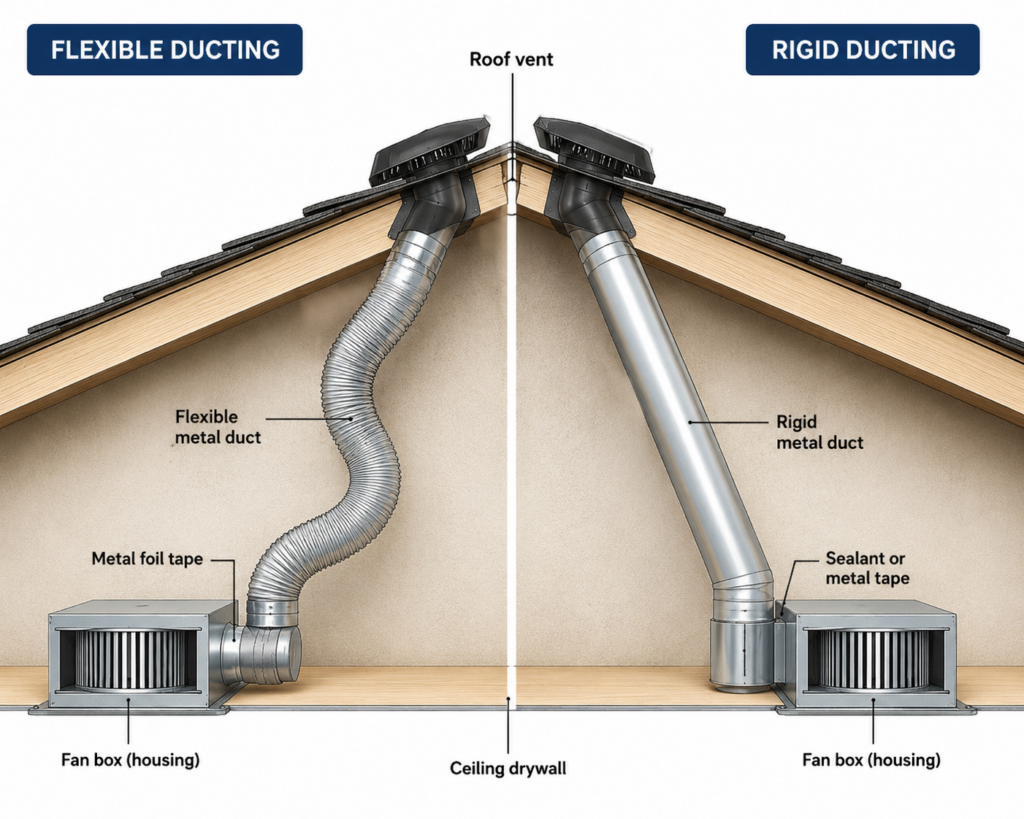
Both flexible metal ducting and rigid metal ducting can be used to connect a bathroom fan or kitchen exhaust hood to a roof vent, but there are important differences.
Flexible Metal Duct
Flexible ducting is easier to install and works well when space is limited or obstacles must be avoided.
Advantages
Easier installation
Lower material cost
Good for retrofit projects
Disadvantages
Corrugated interior slows airflow
Moisture can collect in low spots
Greater airflow resistance
Can sag if not properly supported
Grease from kitchen exhaust can accumulate inside the ridges more easily
Rigid Metal Duct
Rigid metal ducting is generally considered the preferred long-term solution whenever possible.
Its smooth interior allows moisture, smoke, grease particles, and warm air to travel efficiently to the roof vent with less resistance.
Advantages
Better airflow
Less moisture buildup
Reduced grease accumulation
Easier to clean
Longer service life
More energy efficient
Disadvantages
More difficult to install
Requires additional planning
Slightly higher material cost
Proper Installation Matters
Even the best ducting will not perform correctly if it is installed improperly.
Insulated ductwork when required to reduce condensation
An exterior vent equipped with a backdraft damper
Proper flashing around the roof penetration to prevent leaks
Signs Your Bathroom or Kitchen Exhaust May Not Be Properly Vented
You may have an improperly vented exhaust system if you notice:
Mold in the attic
Damp insulation
Frost on roofing nails during winter
Musty odors
Peeling paint in bathrooms
Condensation on windows after showering
Lingering cooking odors
Greasy residue near kitchen cabinets or ceilings
Water stains around bathroom or kitchen ceilings
These warning signs often indicate that moisture and contaminated air are not leaving your home as intended.
A Small Roof Vent That Protects Your Entire Home
Although roof exhaust vents are relatively small, they perform an essential job every single day. By directing warm, humid air, cooking smoke, grease particles, and odors safely outside, they help protect your attic, insulation, framing, and roofing materials from long-term moisture damage.
Whether your home uses flexible metal ducting or rigid metal ducting, the most important factor is ensuring that your bathroom exhaust fans and kitchen range hood are connected to a dedicated roof vent that exhausts completely outside the home—not into the attic or crawlspace.
Proper ventilation improves indoor air quality, helps prevent costly repairs, extends the life of your roofing system, and protects one of your home’s largest investments.
Need Your Bathroom or Kitchen Roof Vent Inspected?
If you’re replacing your roof or aren’t sure where your bathroom exhaust fan or kitchen range hood vents, now is the perfect time to have it inspected. At Portland Roofing Co., we verify that roof penetrations are properly flashed and that bathroom and kitchen exhaust systems are correctly vented through the roofing system to help prevent leaks, moisture damage, mold growth, and costly structural repairs for years to come.
HOA Roof Replacement Doesn’t Have to Be Complicated
Replacing your roof is a major investment, and if your home is located in a Homeowners Association (HOA) community, the process can feel even more overwhelming. Between selecting approved roofing materials, choosing the right colors, and meeting HOA guidelines, it’s easy to feel unsure where to begin.
At Portland Roofing Co., we work with homeowners and rental property owners throughout the Portland metro area to make the roofing process as smooth as possible.
We Help Guide You Through HOA Requirements
Every HOA has different roofing requirements. Some require approval before work begins, while others have specific rules regarding roofing colors, materials, or installation methods.
Our experienced team can help by:
Explaining the roofing process
Assisting with material and color selection
Providing documentation when needed
Scheduling your project efficiently
Completing installation with our experienced in-house crews
Whether you live in the home or own it as a rental property, we’ll help simplify the process from start to finish.
Quality Roofing for HOA Communities
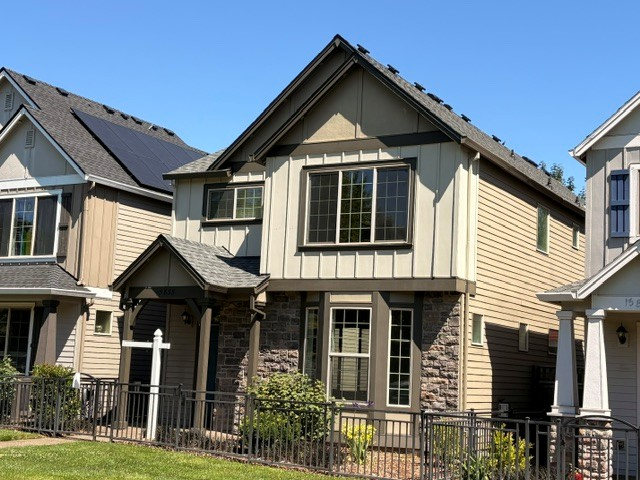
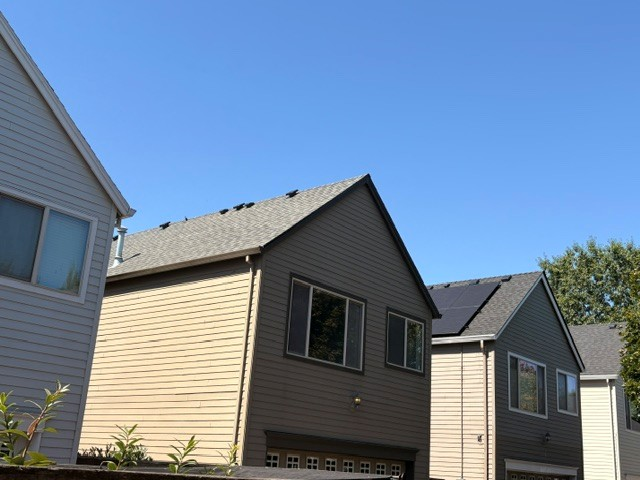
The project featured here is a rental property located in an HOA neighborhood. While every community has its own requirements, having an experienced contractor who understands the process can save homeowners time and unnecessary stress.
Our goal is to provide quality workmanship while helping homeowners feel confident throughout the project.
Used to determine whether a user is included in an A / B or Multivariate test.
18 months
_ga
ID used to identify users
2 years
_gali
Used by Google Analytics to determine which links on a page are being clicked
30 seconds
_ga_
ID used to identify users
2 years
_gid
ID used to identify users for 24 hours after last activity
24 hours
_gat
Used to monitor number of Google Analytics server requests when using Google Tag Manager
1 minute
_gac_
Contains information related to marketing campaigns of the user. These are shared with Google AdWords / Google Ads when the Google Ads and Google Analytics accounts are linked together.
90 days
__utma
ID used to identify users and sessions
2 years after last activity
__utmt
Used to monitor number of Google Analytics server requests
10 minutes
__utmb
Used to distinguish new sessions and visits. This cookie is set when the GA.js javascript library is loaded and there is no existing __utmb cookie. The cookie is updated every time data is sent to the Google Analytics server.
30 minutes after last activity
__utmc
Used only with old Urchin versions of Google Analytics and not with GA.js. Was used to distinguish between new sessions and visits at the end of a session.
End of session (browser)
__utmz
Contains information about the traffic source or campaign that directed user to the website. The cookie is set when the GA.js javascript is loaded and updated when data is sent to the Google Anaytics server
6 months after last activity
__utmv
Contains custom information set by the web developer via the _setCustomVar method in Google Analytics. This cookie is updated every time new data is sent to the Google Analytics server.
2 years after last activity
Marketing cookies are used to follow visitors to websites. The intention is to show ads that are relevant and engaging to the individual user.
Google Maps is a web mapping service providing satellite imagery, real-time navigation, and location-based information.