If you’re wondering, “How much does a roof replacement cost in Portland, Oregon?”, you’re not alone. Roofing costs can vary significantly from one home to another. Because every roof has different features and needs, a professional roofing contractor needs to evaluate the actual roof before providing an accurate estimate.
For example, two homes with similar square footage can have very different roofing costs. However, the size of the home represents only one part of the overall project.
Several factors can affect your total roof replacement cost, including the number of existing roofing layers, roof pitch, decking condition, ventilation, flashing, roof design, materials, repairs, and job-site access.
That’s why a professional roofing estimate should come from an evaluation of your actual roof rather than a quick phone estimate.
Why Can’t a Roofer Give You a Price Over the Phone for a roofing estimate?
It’s understandable that homeowners want a general idea of what a new roof might cost. However, roofing contractors cannot accurately price every project based only on a home’s square footage.
Instead, a contractor needs to evaluate several important factors.
For example, a simple ranch-style home with one layer of roofing may require significantly less work than a home with multiple roofing layers, steep slopes, several valleys, and complicated flashing.
In other words, two roofs that look similar from the street can require very different amounts of labor and materials.
Here are some of the most important factors that can affect your roof replacement cost in Portland, Oregon.
1. How Many Layers of Roofing Are on the Home?
First, your contractor needs to determine how many existing layers cover the roof.
Some homes have only one layer of shingles, while others have multiple layers. As a result, the tear-off process can vary from one project to another.
Removing additional roofing layers requires more labor, time, and disposal. Therefore, the number of existing layers can have a direct impact on your project cost.
A contractor also needs to determine whether the existing roofing materials require special handling or disposal.
2. What Is the Roof Pitch?
Next, your contractor needs to evaluate the roof pitch.
The pitch describes how steeply the roof slopes. Generally, steeper roofs require additional safety precautions and can take more time to work on.
For example, a steep roof may require specialized equipment, additional safety measures, and more labor than a low-slope roof.
Because of these differences, roof pitch plays an important role in determining the labor required for your project.
3. What Condition Is the Roof Decking In?
Underneath your roofing materials, you’ll find the roof decking. This material provides the structural surface that supports your roofing system.
During the roofing process, your contractor may discover damaged, deteriorated, or weakened decking.
Sometimes, homeowners cannot see these problems from the ground. However, your contractor can identify potential issues during the tear-off process.
If the decking needs repairs or replacement, the additional materials and labor can affect the final project cost.
For this reason, a contractor should account for potential decking repairs when explaining your roofing estimate.
4. Does the Home Have Proper Roof Ventilation and will this always be added to the roofing estimate?
In addition to the roof structure itself, your contractor needs to evaluate the ventilation system.
Proper attic and roof ventilation can help manage heat and moisture. Therefore, ventilation plays an important role in the overall roofing system.
Depending on your home’s existing ventilation, your contractor may recommend improvements or replacement of certain ventilation components.
As a result, ventilation requirements can affect both the scope and cost of a roof replacement.
5. How Complicated Is the Roof Design when getting a roofing estimate?
Another important factor is the overall design of your roof.
A simple roof with large, open sections typically requires less work than a complicated roof with multiple sections.
For example, your home may have:
Valleys
Hips
Ridges
Dormers
Additions
Multiple roof sections
Different roof elevations
Roof-to-wall transitions
Because each of these features requires additional planning and installation work, they can affect the total project cost.
In addition, complicated roof designs often require more precise cutting, flashing, and installation.
6. What Flashing Does the Roof Need and will it say in the roofing estimate?
Flashing helps protect areas where water could otherwise enter the roofing system.
For example, flashing may be needed around walls, roof-to-wall transitions, skylights, vents, and chimneys.
Your contractor should evaluate the condition of the existing flashing and determine what the new roofing system requires.
In some cases, existing flashing may remain suitable. In other cases, the contractor may recommend replacement to provide the proper protection for the new roof.
Ultimately, flashing details can affect both the materials and labor required for the project.
7. What Repairs Does the Roof Need?
Before installing a new roof, your contractor should identify visible areas that need repair.
These repairs may involve damaged decking, structural areas, flashing, ventilation components, or other roofing details.
However, some problems may not become visible until the existing roofing materials come off.
That’s why a contractor cannot always determine every repair from a quick visual inspection alone.
A professional contractor should explain any necessary repairs and discuss how they may affect the final cost.
8. How Easy Is It to Access the Property?
Another factor homeowners sometimes overlook is job-site access.
Roofing crews need enough space to safely deliver materials, remove old roofing, set up equipment, and dispose of debris.
For example, fences, landscaping, narrow driveways, detached structures, or limited staging areas can make a project more difficult.
As a result, property access can affect how efficiently a roofing crew can complete the work.
In addition, difficult access may require additional planning or equipment.
9. What Roofing Materials Are You Choosing?
Of course, the roofing materials you select also affect the overall cost.
Different roofing systems have different material costs, installation requirements, warranties, and expected lifespans.
Your estimate may include materials such as:
Asphalt roofing shingles
Underlayment
Ice and water protection
Ridge and hip materials
Ventilation products
Flashing
Roofing accessories
Other installation components
Most importantly, homeowners should compare complete roofing systems rather than comparing shingle prices alone.
A lower-priced material does not necessarily mean a lower overall project cost. Instead, consider the quality of the materials, installation specifications, warranties, and overall value.
Why a Cheap “Ballpark” Price Can Be Misleading
It can be tempting to choose a contractor who gives you the lowest number over the phone.
However, a quick ballpark price may leave out important details.
For example, the initial number may not account for additional roofing layers, decking repairs, flashing, ventilation, difficult access, or other necessary work.
As a result, the final cost could increase once the contractor evaluates the roof in person.
At Portland Roofing Co., we believe homeowners deserve a realistic estimate from the beginning.
Rather than giving you a low number just to get your attention, we prefer to evaluate your roof and explain the work your home actually needs.
That way, you can make a more informed decision before the project begins.
What Should You Expect From a Professional Roofing Estimate?
A professional roofing estimate should clearly explain the work included in your project.
For example, your estimate should provide information about the roofing system, preparation, tear-off, installation, repairs, and other project requirements.
In addition, your contractor should be willing to answer questions about the materials, warranties, installation process, and expected timeline.
You should also understand what the estimate does and does not include.
Most importantly, don’t be afraid to ask questions. A good roofing contractor should want you to understand your project before you sign a contract.
Your Roof Is Unique—Your Estimate Should Be Too
So, how much does a roof replacement cost in Portland, Oregon?
The honest answer depends on your specific home.
Because roofing projects involve much more than square footage, a contractor needs to evaluate the actual roof before providing an accurate price.
The number of existing layers, roof pitch, decking condition, ventilation, roof design, flashing, repairs, accessibility, and materials can all affect the final cost.
For this reason, we don’t believe in giving homeowners a random number over the phone.
At Portland Roofing Co., we evaluate your roof, explain what we find, and provide an estimate based on your home’s specific needs.
In the end, an accurate estimate helps you understand what you’re paying for and reduces the risk of unexpected costs later.
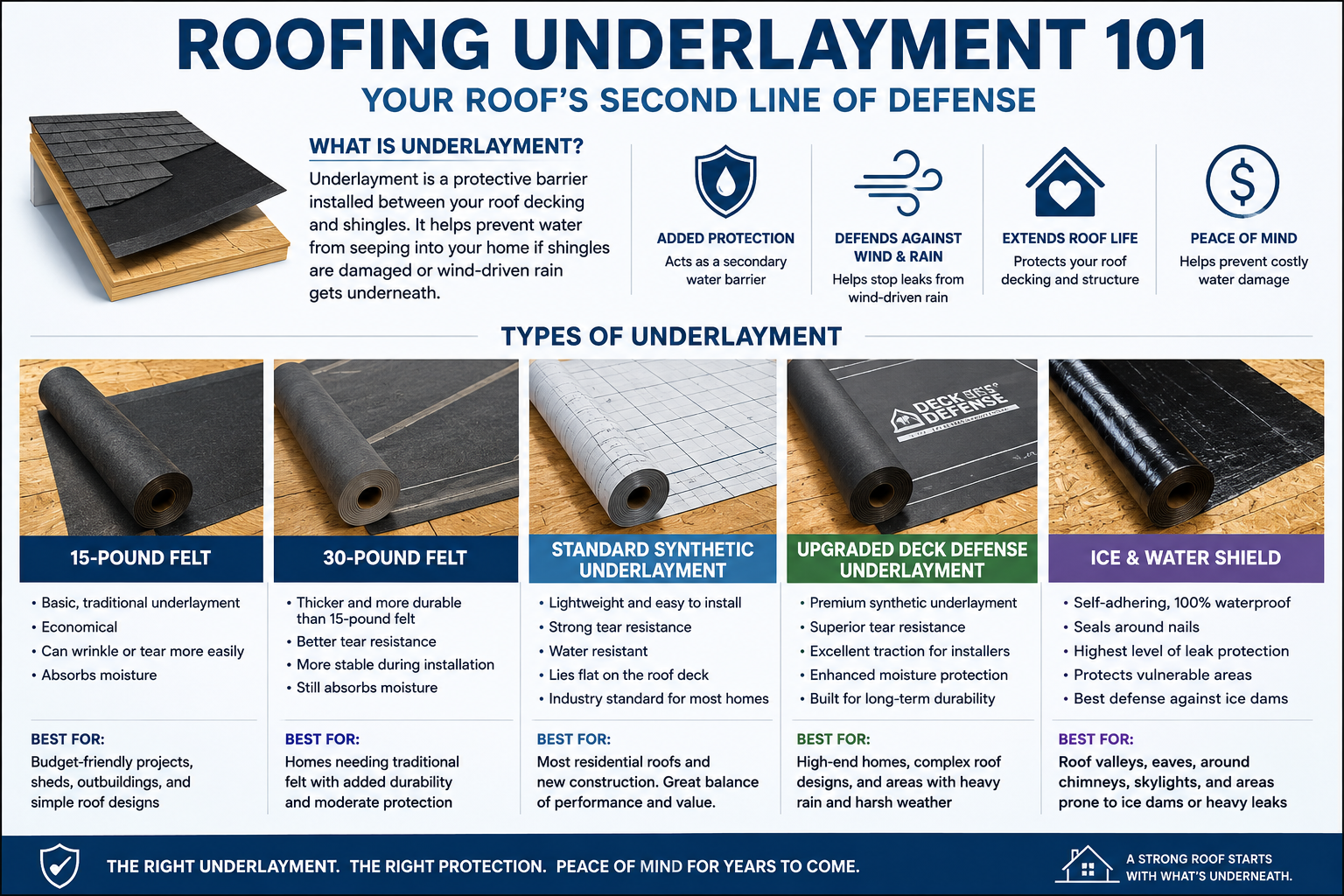
Roofing underlayment is the protective layer installed between your roof decking and your shingles. It serves as a secondary water barrier and helps protect your home if wind-driven rain, ice, or damaged shingles allow water to get beneath the roofing material. (https://portlandroofingco.com/recent-work/)
Not all underlayments are the same. Each type offers different levels of protection, durability, and cost.
Better performance during rainy installation periods
Disadvantages
Higher cost than felt
Protection level varies by manufacturer
Best For
Most residential roof replacements
New construction
Homes in the Pacific Northwest
Homeowners seeking better protection without a major upgrade
Upgraded Deck Defense Underlayment
Deck Defense is a premium synthetic underlayment designed to provide enhanced protection and durability compared to standard synthetic products.
Advantages
Superior tear resistance
Excellent traction for installers
Better moisture protection
More durable during extended exposure
Helps provide a stronger roofing system
Disadvantages
Higher initial investment
Best For
Homes with complex roof designs
Higher-end roofing systems
Long-term homeowners
Areas with heavy rain and wind exposure
Ice & Water Shield
Ice & Water Shield is a self-adhering waterproof membrane that seals around nails and provides the highest level of leak protection available beneath shingles.
Advantages
100% waterproof
Self-sealing around roofing nails
Superior leak protection
Protects vulnerable roof areas
Excellent defense against wind-driven rain and ice dams
Disadvantages
Highest cost
More difficult to remove during future roof replacements
Best For
Roof valleys
Eaves and overhangs
Around chimneys and skylights
Low-slope roof sections
Areas prone to ice dams
Homes in wet climates like Oregon and Washington
Which Underlayment Should Your Roof Have?
Basic Protection
15-pound or 30-pound felt
Rental properties
Outbuildings
Budget-focused projects
Good Protection (Most Homes)
Standard synthetic underlayment
Most residential roofs
Typical Portland-area homes
Excellent balance of cost and performance
Better Protection
Upgraded Deck Defense
Long-term homeowners
Higher-value homes
Roofs exposed to heavy weather
Best Protection
Full synthetic or Deck Defense system with Ice & Water Shield in critical areas
Valleys
Roof penetrations
Eaves
Low-slope sections
This is the system many professional roofing contractors recommend because it provides excellent overall protection while targeting the most leak-prone areas with the highest level of waterproofing.
Portland Roofing Company’s Recommendation
Each home is as unique as it’s owner and there is not one standard way we would recommend for everyone. We provide free estimates so reach out and we can get all of the necessary information to let you know what we would recommend just for you! (https://app.acuityscheduling.com/schedule/5e3b2ef3)
Remember: Shingles are your roof’s first line of defense. Underlayment is your home’s backup protection when severe weather, aging shingles, or unexpected damage occur. Investing in quality underlayment can help prevent costly repairs and provide added peace of mind for years to come.
Cookie Consent
We use cookies to improve your experience on our site. By using our site, you consent to cookies.
Used to determine whether a user is included in an A / B or Multivariate test.
18 months
_ga
ID used to identify users
2 years
_gali
Used by Google Analytics to determine which links on a page are being clicked
30 seconds
_ga_
ID used to identify users
2 years
_gid
ID used to identify users for 24 hours after last activity
24 hours
_gat
Used to monitor number of Google Analytics server requests when using Google Tag Manager
1 minute
_gac_
Contains information related to marketing campaigns of the user. These are shared with Google AdWords / Google Ads when the Google Ads and Google Analytics accounts are linked together.
90 days
__utma
ID used to identify users and sessions
2 years after last activity
__utmt
Used to monitor number of Google Analytics server requests
10 minutes
__utmb
Used to distinguish new sessions and visits. This cookie is set when the GA.js javascript library is loaded and there is no existing __utmb cookie. The cookie is updated every time data is sent to the Google Analytics server.
30 minutes after last activity
__utmc
Used only with old Urchin versions of Google Analytics and not with GA.js. Was used to distinguish between new sessions and visits at the end of a session.
End of session (browser)
__utmz
Contains information about the traffic source or campaign that directed user to the website. The cookie is set when the GA.js javascript is loaded and updated when data is sent to the Google Anaytics server
6 months after last activity
__utmv
Contains custom information set by the web developer via the _setCustomVar method in Google Analytics. This cookie is updated every time new data is sent to the Google Analytics server.
2 years after last activity
Marketing cookies are used to follow visitors to websites. The intention is to show ads that are relevant and engaging to the individual user.
Google Maps is a web mapping service providing satellite imagery, real-time navigation, and location-based information.