If you’re wondering, “How much does a roof replacement cost in Portland, Oregon?”, you’re not alone. Roofing costs can vary significantly from one home to another. Because every roof has different features and needs, a professional roofing contractor needs to evaluate the actual roof before providing an accurate estimate.
For example, two homes with similar square footage can have very different roofing costs. However, the size of the home represents only one part of the overall project.
Several factors can affect your total roof replacement cost, including the number of existing roofing layers, roof pitch, decking condition, ventilation, flashing, roof design, materials, repairs, and job-site access.
That’s why a professional roofing estimate should come from an evaluation of your actual roof rather than a quick phone estimate.
Why Can’t a Roofer Give You a Price Over the Phone for a roofing estimate?
It’s understandable that homeowners want a general idea of what a new roof might cost. However, roofing contractors cannot accurately price every project based only on a home’s square footage.
Instead, a contractor needs to evaluate several important factors.
For example, a simple ranch-style home with one layer of roofing may require significantly less work than a home with multiple roofing layers, steep slopes, several valleys, and complicated flashing.
In other words, two roofs that look similar from the street can require very different amounts of labor and materials.
Here are some of the most important factors that can affect your roof replacement cost in Portland, Oregon.
1. How Many Layers of Roofing Are on the Home?
First, your contractor needs to determine how many existing layers cover the roof.
Some homes have only one layer of shingles, while others have multiple layers. As a result, the tear-off process can vary from one project to another.
Removing additional roofing layers requires more labor, time, and disposal. Therefore, the number of existing layers can have a direct impact on your project cost.
A contractor also needs to determine whether the existing roofing materials require special handling or disposal.
2. What Is the Roof Pitch?
Next, your contractor needs to evaluate the roof pitch.
The pitch describes how steeply the roof slopes. Generally, steeper roofs require additional safety precautions and can take more time to work on.
For example, a steep roof may require specialized equipment, additional safety measures, and more labor than a low-slope roof.
Because of these differences, roof pitch plays an important role in determining the labor required for your project.
3. What Condition Is the Roof Decking In?
Underneath your roofing materials, you’ll find the roof decking. This material provides the structural surface that supports your roofing system.
During the roofing process, your contractor may discover damaged, deteriorated, or weakened decking.
Sometimes, homeowners cannot see these problems from the ground. However, your contractor can identify potential issues during the tear-off process.
If the decking needs repairs or replacement, the additional materials and labor can affect the final project cost.
For this reason, a contractor should account for potential decking repairs when explaining your roofing estimate.
4. Does the Home Have Proper Roof Ventilation and will this always be added to the roofing estimate?
In addition to the roof structure itself, your contractor needs to evaluate the ventilation system.
Proper attic and roof ventilation can help manage heat and moisture. Therefore, ventilation plays an important role in the overall roofing system.
Depending on your home’s existing ventilation, your contractor may recommend improvements or replacement of certain ventilation components.
As a result, ventilation requirements can affect both the scope and cost of a roof replacement.
5. How Complicated Is the Roof Design when getting a roofing estimate?
Another important factor is the overall design of your roof.
A simple roof with large, open sections typically requires less work than a complicated roof with multiple sections.
For example, your home may have:
Valleys
Hips
Ridges
Dormers
Additions
Multiple roof sections
Different roof elevations
Roof-to-wall transitions
Because each of these features requires additional planning and installation work, they can affect the total project cost.
In addition, complicated roof designs often require more precise cutting, flashing, and installation.
6. What Flashing Does the Roof Need and will it say in the roofing estimate?
Flashing helps protect areas where water could otherwise enter the roofing system.
For example, flashing may be needed around walls, roof-to-wall transitions, skylights, vents, and chimneys.
Your contractor should evaluate the condition of the existing flashing and determine what the new roofing system requires.
In some cases, existing flashing may remain suitable. In other cases, the contractor may recommend replacement to provide the proper protection for the new roof.
Ultimately, flashing details can affect both the materials and labor required for the project.
7. What Repairs Does the Roof Need?
Before installing a new roof, your contractor should identify visible areas that need repair.
These repairs may involve damaged decking, structural areas, flashing, ventilation components, or other roofing details.
However, some problems may not become visible until the existing roofing materials come off.
That’s why a contractor cannot always determine every repair from a quick visual inspection alone.
A professional contractor should explain any necessary repairs and discuss how they may affect the final cost.
8. How Easy Is It to Access the Property?
Another factor homeowners sometimes overlook is job-site access.
Roofing crews need enough space to safely deliver materials, remove old roofing, set up equipment, and dispose of debris.
For example, fences, landscaping, narrow driveways, detached structures, or limited staging areas can make a project more difficult.
As a result, property access can affect how efficiently a roofing crew can complete the work.
In addition, difficult access may require additional planning or equipment.
9. What Roofing Materials Are You Choosing?
Of course, the roofing materials you select also affect the overall cost.
Different roofing systems have different material costs, installation requirements, warranties, and expected lifespans.
Your estimate may include materials such as:
Asphalt roofing shingles
Underlayment
Ice and water protection
Ridge and hip materials
Ventilation products
Flashing
Roofing accessories
Other installation components
Most importantly, homeowners should compare complete roofing systems rather than comparing shingle prices alone.
A lower-priced material does not necessarily mean a lower overall project cost. Instead, consider the quality of the materials, installation specifications, warranties, and overall value.
Why a Cheap “Ballpark” Price Can Be Misleading
It can be tempting to choose a contractor who gives you the lowest number over the phone.
However, a quick ballpark price may leave out important details.
For example, the initial number may not account for additional roofing layers, decking repairs, flashing, ventilation, difficult access, or other necessary work.
As a result, the final cost could increase once the contractor evaluates the roof in person.
At Portland Roofing Co., we believe homeowners deserve a realistic estimate from the beginning.
Rather than giving you a low number just to get your attention, we prefer to evaluate your roof and explain the work your home actually needs.
That way, you can make a more informed decision before the project begins.
What Should You Expect From a Professional Roofing Estimate?
A professional roofing estimate should clearly explain the work included in your project.
For example, your estimate should provide information about the roofing system, preparation, tear-off, installation, repairs, and other project requirements.
In addition, your contractor should be willing to answer questions about the materials, warranties, installation process, and expected timeline.
You should also understand what the estimate does and does not include.
Most importantly, don’t be afraid to ask questions. A good roofing contractor should want you to understand your project before you sign a contract.
Your Roof Is Unique—Your Estimate Should Be Too
So, how much does a roof replacement cost in Portland, Oregon?
The honest answer depends on your specific home.
Because roofing projects involve much more than square footage, a contractor needs to evaluate the actual roof before providing an accurate price.
The number of existing layers, roof pitch, decking condition, ventilation, roof design, flashing, repairs, accessibility, and materials can all affect the final cost.
For this reason, we don’t believe in giving homeowners a random number over the phone.
At Portland Roofing Co., we evaluate your roof, explain what we find, and provide an estimate based on your home’s specific needs.
In the end, an accurate estimate helps you understand what you’re paying for and reduces the risk of unexpected costs later.
Protecting Your Home Starts Before the First Shingle Is Installed
Replacing or repairing your roof is one of the largest investments you will make in your home. While many homeowners compare prices, not everyone understands that choosing the lowest bid can sometimes become the most expensive decision in the long run. why its so critical to hire a licensed roofer before it’s too late.
A professional roofing contractor offers much more than shingles and labor. They provide experience, accountability, proper licensing, insurance protection, and established safety practices that help protect your home, your family, and your financial investment.
Before signing a contract, it is important to understand what it means for a roofing company to be licensed, bonded, insured, and committed to maintaining safe job sites.
Why Licensing Matters
A roofing contractor’s license is much more than a number printed on a business card. It demonstrates that the contractor has met state requirements and is legally authorized to perform roofing work.
Licensed contractors are generally required to maintain current registrations, meet financial responsibility requirements, and comply with applicable state laws and regulations governing construction work.
Hiring a licensed contractor helps provide homeowners with greater confidence that the company operates as a legitimate business rather than an individual performing roofing work without oversight.
A licensed roofing contractor is also more likely to:
• Follow local building codes
• Obtain required permits when necessary
• Complete projects according to manufacturer installation requirements
• Stay current on changing building standards
• Operate with established business practices
Unlicensed contractors often advertise lower prices because they may not carry the same business expenses required of legitimate contractors. While that lower price may seem attractive initially, homeowners could face significant financial risks if problems arise during or after the project.
Many homeowners hear the word “bonded” but are unsure what it actually means.
A contractor bond helps provide financial protection in certain situations if a contractor fails to fulfill obligations covered by the bond. Although bonds have limitations and specific terms, they demonstrate that the contractor has met bonding requirements established by the state or licensing authority.
Being bonded also reflects a contractor’s willingness to operate responsibly and meet professional standards.
Working with a bonded contractor provides additional peace of mind because the contractor has invested in meeting higher business qualifications.
Why Insurance Is One of the Most Important Things to Verify
Insurance is one of the most overlooked—but most important—factors when hiring a roofing contractor.
Roofing is consistently recognized as one of the most hazardous occupations in construction. Crews work at heights, use ladders, operate power tools, handle heavy materials, and are exposed to changing weather conditions.
Because of these risks, reputable roofing companies invest heavily in insurance coverage.
There are two primary types of insurance homeowners should ask about.
General Liability Insurance
General liability insurance is designed to provide protection if covered property damage or certain accidents occur during the course of the roofing project.
Without adequate liability insurance, a homeowner could face significant complications if property is damaged during construction.
Always ask for proof of current insurance before work begins.
Workers’ Compensation Insurance
Workers’ compensation insurance protects employees who may be injured while working.
If a contractor does not carry workers’ compensation insurance when required, homeowners may face unexpected legal or financial issues depending on applicable laws and the specific circumstances.
A professional contractor should have no hesitation in providing proof of insurance upon request.
Why Safety Practices Matter
Safety is not simply about complying with regulations.
It is about protecting people.
A professional roofing company develops safety procedures that reduce risk before work even begins.
These procedures often include:
• Daily safety meetings
• Proper ladder placement
• Fall protection systems
• Roof anchors
• Personal fall arrest equipment
• Controlled material loading
• Tool safety
• Weather monitoring
• Site cleanup
• Debris management
• Emergency response planning
When contractors ignore safety procedures, they increase the chances of injuries, property damage, project delays, and insurance claims.
High winds, heavy rain, lightning, excessive heat, freezing temperatures, and wildfire smoke can all affect roofing operations.
Professional companies often adjust schedules when conditions become unsafe.
Sometimes homeowners become frustrated when projects are delayed due to weather.
However, responsible contractors understand that delaying work for safety reasons is often the right decision.
Protecting workers and protecting your home should always come before rushing to finish a project.
Why Cheap Roofing Can Become Expensive
Every homeowner wants a fair price.
However, there is a significant difference between a fair price and the lowest price.
Extremely low bids may indicate that a contractor is cutting costs somewhere.
Examples may include:
• No insurance
• No workers’ compensation
• Improper licensing
• Inexperienced labor
• Inferior materials
• Poor installation practices
• Lack of supervision
• Minimal warranties
• Inadequate safety equipment
While these shortcuts reduce the contractor’s expenses, they can increase the homeowner’s risk.
Quality roofing is an investment that protects your home for decades.
Portland Roofing Company has over 50 years of experience which allows us to avoid some of the pitfalls that new contractors can make. it takes years to perfect processes correctly to do it right. more info at: https://portlandroofingco.com/
Questions Every Homeowner Should Ask
Before hiring a roofing contractor, consider asking:
Are you properly licensed?
Can you provide proof of general liability insurance?
Professional roofing companies invest substantial resources into training, insurance, equipment, continuing education, safety programs, quality control, and customer service.
These investments may not always be visible in the estimate, but they are reflected in the quality of the finished roof and the protection provided throughout the project.
Choosing a qualified contractor is about more than completing a roofing project. It is about protecting one of your family’s largest investments.
Choose Confidence, Not Just a Contractor
Your roof protects everything beneath it—your family, your belongings, and your home.
Choosing a licensed, bonded, insured roofing contractor that follows established safety procedures helps reduce unnecessary risks and provides greater peace of mind throughout the roofing process.
At Portland Roofing Company LLC, we believe every homeowner deserves quality craftsmanship, honest communication, professional service, and a strong commitment to safety. We are proud to follow industry best practices and strive to deliver roofing solutions that homeowners can rely on for years to come.
When comparing roofing contractors, remember that the lowest price is only one part of the decision. Experience, accountability, safety, and professionalism are investments that continue long after the last shingle is installed.
Because when it comes to protecting your home, doing the job right the first time matters. Feel free to book at online appointment by clicking on the link at : https://app.acuityscheduling.com/schedule/5e3b2ef3 or copy and paste in your browser. if you would like additional information you can email us at: info@portlandroofingco.com or call at 503-490-3994.
When you hire a female-owned company, you’re supporting entrepreneurship, leadership, and diversity within an industry that has traditionally been male-dominated.
Construction and roofing have changed significantly over the years.
Today, homeowners have more choices than ever and can choose companies that align with their values.
Supporting women-owned businesses helps create opportunities for future generations while encouraging innovation and fresh perspectives within the construction industry. If you want to book a no cost estimate with us you can at: book an appointment yourself online at https://portlandroofingco.com/
When most people think about roofing, they picture hammers, shingles, ladders, and construction crews. What many don’t think about is the importance of communication, organization, customer service, and accountability, the very things that can make or break your roofing experience.
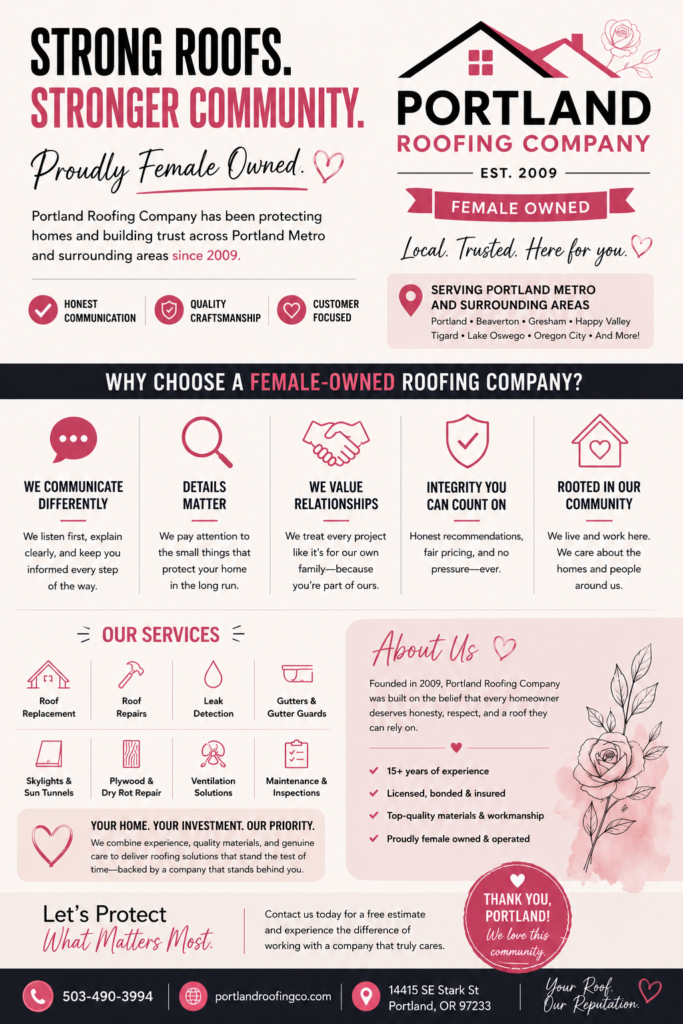
At Portland Roofing Company, we’re proud to be a female-owned roofing company serving Portland, Oregon and the surrounding metro area since 2009.
For more than 15 years, we’ve helped homeowners protect their biggest investment: their home. Along the way, we’ve learned that great roofing isn’t just about installing shingles. It’s about trust, communication, honesty, and treating people with respect.
So why do many homeowners specifically seek out female-owned businesses when choosing a roofing contractor?
✨ We Focus on Communication
One of the most common complaints homeowners have about contractors is poor communication.`
Customers often tell us stories about contractors who don’t return calls, fail to explain the process, or leave them wondering what’s happening with their project.
At Portland Roofing Company, we believe communication is just as important as craftsmanship.
We take time to explain:
✔ What we’re seeing on your roof ✔ What needs immediate attention ✔ What can wait ✔ Available options and price ranges ✔ The pros and cons of each solution ✔ What to expect before, during, and after installation
An informed customer can make confident decisions.
✨ We Listen Before We Sell
Many roofing companies focus on selling a roof.
We focus on solving a problem.
Every homeowner has unique concerns:
• Is the roof leaking? • Are they preparing to sell? • Is this their forever home? • Are they working within a budget? • Do they need financing? • Are they worried about insurance?
We take the time to understand your goals before recommending a solution.
Sometimes the answer is a full replacement.
Sometimes the answer is a repair.
Sometimes the answer is simply education.
Our goal is to help homeowners make the best decision for their situation.
Missing one small detail can lead to major problems later.
We believe that success comes from paying attention to the details that others may overlook.
That’s why we carefully inspect every project and communicate findings to homeowners along the way.
✨ A Different Approach to Customer Service
As a female-owned business, we believe customer service should never be an afterthought.
From the first phone call to the final cleanup, we want homeowners to feel comfortable asking questions and expressing concerns.
No pressure.
No scare tactics.
No confusing industry jargon.
Just honest information and straightforward recommendations.
Many of our customers tell us they appreciate having a roofing company that takes the time to explain things clearly and treats them like family.
✨ We Value Relationships Over Transactions
We’ve been serving the Portland Metro area since 2009.
That longevity didn’t happen by accident.
Many of our projects come from referrals, repeat customers, family members, neighbors, and friends of previous customers.
We understand that every project represents our reputation.
When we install a roof, we’re not just completing a job.
We’re building a long-term relationship.
✨ Supporting Women-Owned Businesses Matters
When you hire a female-owned company, you’re supporting entrepreneurship, leadership, and diversity within an industry that has traditionally been male-dominated. If you are interested in the trades in Portland metro
Construction and roofing have changed significantly over the years.
Today, homeowners have more choices than ever and can choose companies that align with their values.
Supporting women-owned businesses helps create opportunities for future generations while encouraging innovation and fresh perspectives within the construction industry. one resource for women in the trades can be found at https://oregontradeswomen.org/
✨ Local Matters
Portland Roofing Company isn’t a national chain.
We’re local.
We understand the unique weather challenges of the Pacific Northwest:
🌧 Heavy rainfall 🌧 Moss and algae growth 🌧 Wind-driven rain 🌧 Seasonal storms 🌧 Moisture-related roof deterioration
Because we live and work here, we know what roofing systems perform best in our climate and what homeowners should watch for as their roofs age.
✨ Experience Matters
Since 2009, we’ve completed thousands of roofing projects throughout:
📍 Portland 📍 Beaverton 📍 Gresham 📍 Happy Valley 📍 Oregon City 📍 Milwaukie 📍 Tigard 📍 Lake Oswego 📍 Vancouver 📍 And surrounding communities
Our experience allows us to identify issues quickly and provide practical solutions that fit your home’s needs and budget.
Our goal is to provide complete roofing solutions under one roof.
✨ Thank You Portland
As a female-owned company, we are grateful for the trust our customers have placed in us over the years.
Every estimate, referral, review, and completed project has helped us grow into the company we are today.
We know you have many choices when selecting a roofing contractor.
Thank you for considering Portland Roofing Company.
Women-owned businesses
if you would like some additional resources for woemn entrepreneurs, you can visit SBA helps women entrepreneurs launch new businesses and compete in the marketplace. Connect with the training and funding opportunities specifically for women.
or https://nawic.org/ which is the National association of women in construction for more information on this topic.
Since 2009, we’ve been committed to protecting homes throughout the Portland Metro area with quality workmanship, honest communication, and customer service that puts people first.
🏠 Portland Roofing Company 📍 Serving Portland Metro & Surrounding Areas 👷 Female-Owned Since 2009 📞 Contact us today for a free roofing estimate. or book yourself online at https://portlandroofingco.com/
Your Roof. Our Reputation.
If you are interested in starting your own business and dont know where to start, you can find more information at https://dreambuilder.org/ women leave with a business plan to start their own business or develop an existing one.
Many homeowners are surprised when a roofing contractor recommends replacing sections of roof decking during a roof replacement project. After all, if the roof isn’t leaking, why would the plywood or OSB underneath need to be replaced?
One common reason is the presence of ice and water shield.
Ice and water shield is one of the most effective roofing products available for protecting homes from leaks caused by ice dams, wind-driven rain, and water intrusion. However, years later when the roof reaches the end of its lifespan, that same protection can make roof tear-offs significantly more difficult. https://www.rooferscoffeeshop.uk/forum/topic/tearing-off-shingles-on-ice-and-watershield
What Is Ice & Water Shield?
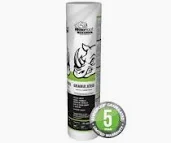
Ice and water shield is a self-adhering waterproof membrane installed directly onto the roof decking before shingles are applied. It is commonly installed along eaves, valleys, around chimneys, skylights, and other vulnerable roof areas.
Unlike traditional roofing felt or synthetic underlayment, ice and water shield contains a rubberized asphalt backing designed to permanently bond to the roof deck and create a watertight seal around roofing nails.
This added protection helps prevent leaks if water manages to get beneath the shingles.
Why Does Ice & Water Shield Become So Difficult to Remove?
Over time, the adhesive backing can bond aggressively to the roof decking. Several factors contribute to this process.
Years of Heat Exposure
Roofs experience extreme temperatures throughout the year. During hot summer months, roof surfaces can reach well over 150 degrees.
As the membrane heats and cools repeatedly over many years, the adhesive can penetrate deeper into the wood fibers, creating a much stronger bond than when it was first installed.
Type of Roofing Membrane
Not all ice and water shield products are created equal. Premium roofing membranes often contain stronger adhesives designed to provide long-term leak protection.
While this is excellent for protecting the home, it can make future roof removal more challenging.
Roof Decking Material
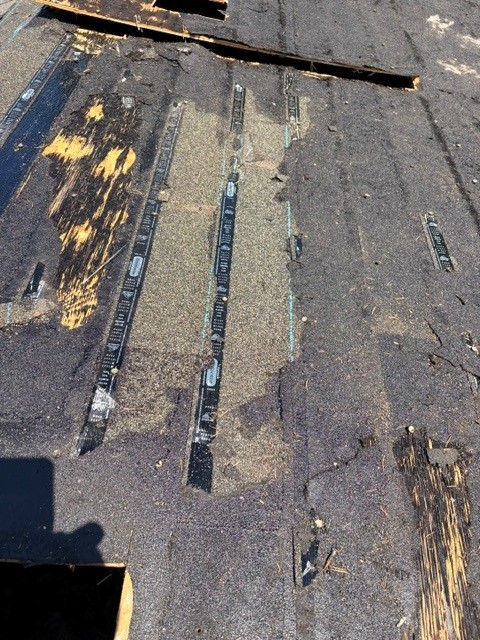
Older plywood and OSB often have rougher surfaces that allow adhesives to penetrate deeper into the wood grain. As a result, removing the membrane may pull up wood fibers or damage the decking surface.
Poor Attic Ventilation
Inadequate attic ventilation can lead to excessive heat buildup beneath the roof. Higher temperatures can accelerate adhesive bonding and increase the likelihood of decking damage during future roof replacements.
Why Are Shingles Sometimes Harder to Remove?
Homeowners often notice that roofing crews spend more time removing shingles in areas protected by ice and water shield.
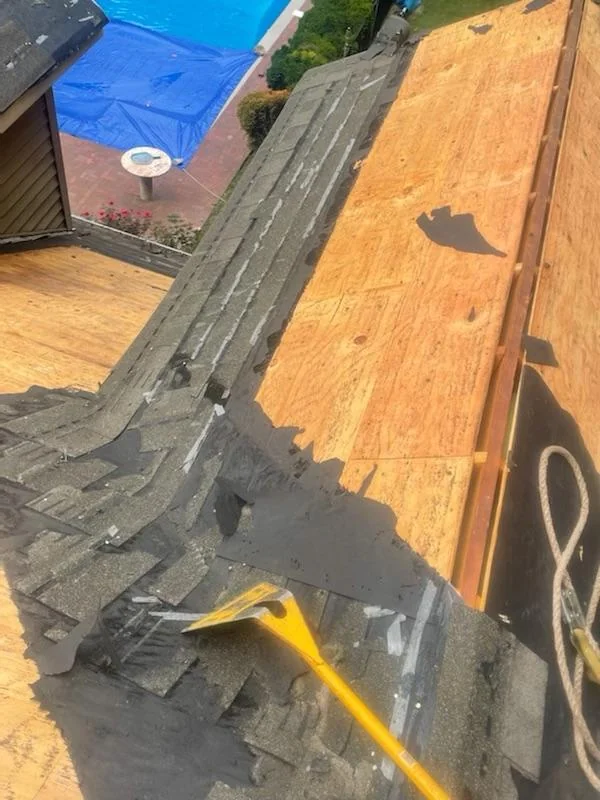
This happens because the shingles, nails, underlayment, and membrane below have effectively become a tightly bonded roofing system over time. Instead of separating into layers during tear-off, the materials often resist removal together.
The result is a slower, more labor-intensive tear-off process.
Why Roof Decking Sometimes Needs Replacement
During roof replacement, contractors may discover areas where the membrane is bonded so tightly that removing it damages the underlying plywood or OSB.
In these situations, replacing affected sections of decking is often the best solution because it:
Provides a smooth surface for the new roofing system
Helps ensure proper shingle installation
Prevents future roofing issues
Maintains the structural integrity of the roof
Attempting to install new roofing materials over damaged decking can lead to long-term performance problems.
Is Ice & Water Shield Still Worth It?
Absolutely.
Despite the challenges it can create during future roof replacements, ice and water shield remains one of the most important components of a high-quality roofing system.
Ice and water shield is designed to protect your home by creating a waterproof barrier beneath your shingles. Over time, that barrier can bond tightly to the roof decking, making roof tear-offs more difficult and sometimes causing damage to the plywood or OSB underneath.
If your roofing contractor recommends replacing sections of roof decking during a roof replacement, it is often because removing old ice and water shield has compromised the surface. Replacing damaged decking helps ensure your new roof is installed on a solid foundation and will perform properly for years to come.
If you’re considering a roof replacement and have questions about your roof decking, underlayment, or ice and water shield, contact Portland Roofing Company for a professional roof inspection and honest recommendations. https://portlandroofingco.com/contact/
Cookie Consent
We use cookies to improve your experience on our site. By using our site, you consent to cookies.
Used to determine whether a user is included in an A / B or Multivariate test.
18 months
_ga
ID used to identify users
2 years
_gali
Used by Google Analytics to determine which links on a page are being clicked
30 seconds
_ga_
ID used to identify users
2 years
_gid
ID used to identify users for 24 hours after last activity
24 hours
_gat
Used to monitor number of Google Analytics server requests when using Google Tag Manager
1 minute
_gac_
Contains information related to marketing campaigns of the user. These are shared with Google AdWords / Google Ads when the Google Ads and Google Analytics accounts are linked together.
90 days
__utma
ID used to identify users and sessions
2 years after last activity
__utmt
Used to monitor number of Google Analytics server requests
10 minutes
__utmb
Used to distinguish new sessions and visits. This cookie is set when the GA.js javascript library is loaded and there is no existing __utmb cookie. The cookie is updated every time data is sent to the Google Analytics server.
30 minutes after last activity
__utmc
Used only with old Urchin versions of Google Analytics and not with GA.js. Was used to distinguish between new sessions and visits at the end of a session.
End of session (browser)
__utmz
Contains information about the traffic source or campaign that directed user to the website. The cookie is set when the GA.js javascript is loaded and updated when data is sent to the Google Anaytics server
6 months after last activity
__utmv
Contains custom information set by the web developer via the _setCustomVar method in Google Analytics. This cookie is updated every time new data is sent to the Google Analytics server.
2 years after last activity
Marketing cookies are used to follow visitors to websites. The intention is to show ads that are relevant and engaging to the individual user.
Google Maps is a web mapping service providing satellite imagery, real-time navigation, and location-based information.